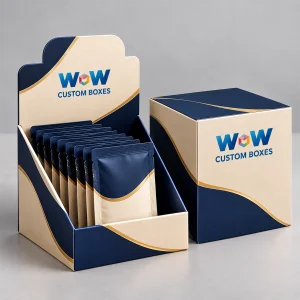
Custom Corrugated Bins for Retail Display and Organization
Corrugated bins turn open space into accessible storage or selling capacity. In retail, they invite customers to browse packaged merchandise without the formality of individual shelf facings. In back rooms, offices, fulfillment areas, and workshops, they can separate lightweight items and simplify picking. Wow Custom Boxes can develop each bin around the contents, weight, quantity, footprint, access method, campaign duration, and movement requirements rather than relying on a one-size structure.
The term covers floor-standing dump bins, smaller shelf bins, compartment units, stackable organizers, and pallet-scale promotional containers. A retail bin usually provides a large open top or front cutout, whereas an organizational bin may prioritize labels, handles, and repeat access. As part of a wider custom display program, headers and side panels can communicate a campaign while the open product well keeps inventory easy to reach.
Retail Dump Bins That Encourage Browsing
Dump bins are useful for flexible packs, small boxes, accessories, clearance items, seasonal products, and mixed merchandise. The open format supports quick replenishment and high product visibility. However, the unit must remain stable when customers lean toward it or remove stock unevenly. Base width, wall height, center of gravity, product density, and internal support all matter. A false bottom can raise merchandise toward the opening so a partly filled bin still appears accessible.
Experience with corrugated packaging helps determine flute, wall construction, fold direction, and reinforcement. A lightweight snack promotion differs from a bin holding bottles or dense hardware. If a load exceeds practical paper-based limits, the design may require reduced capacity, separate cells, stronger components, or another material system. Verified product weight should always guide the final structure.
Storage and Picking Applications
Shelf bins can organize parts, printed materials, sealed samples, accessories, and fulfillment supplies. A sloped or cutaway front gives workers access while sidewalls maintain containment. Label panels and color coding help distinguish SKUs. Stackable designs require engineered load paths so upper units do not crush lower openings. Corrugated organizers are generally best for clean, dry environments and loads suited to their board specification; moisture, oils, sharp parts, and repeated abrasion may reduce service life.
| Bin style | Primary use | Helpful features |
|---|---|---|
| Floor dump bin | Promotions and bulk browsing | Header, false bottom, reinforced base |
| Shelf bin | Picking and small-item storage | Front cutout, label panel, dividers |
| Compartment bin | Sorting multiple variants | Partitions, printed identifiers, equal cells |
| Stackable bin | Vertical storage organization | Supported corners and controlled loads |
| Pallet bin | High-volume retail campaigns | Large footprint and transport planning |
Board, Liners, and Reinforcement
Single-wall board can suit many temporary displays and lighter storage loads. Double-wall constructions or laminated panels may be used when the contents, span, or expected duration demands additional stiffness. Reinforced top edges reduce wear around the opening, while a multi-layer base distributes load. Internal sleeves or cross partitions prevent walls from bowing. Board should be specified according to measured requirements, not simply described as “heavy duty” without a defined payload and environment.
Brands can coordinate bin graphics with their cardboard boxes, using matching colors, logos, icons, and campaign language. Standardized artwork creates a stronger brand block even when the unit contains mixed pack sizes. For organizational use, simple one- or two-color identification may be more practical than full coverage. Large writable or label-ready areas can support changing inventory and warehouse workflows.
Printing for Fast Recognition
Flexographic printing is widely used for direct graphics on corrugated material, while litho-laminated surfaces can deliver detailed imagery and retail-quality color. Digital printing may support shorter campaigns and versioned graphics. Headers are the most visible communication area, followed by upper sidewalls and front lips. Artwork should account for products covering lower panels. Short messages, strong contrast, and a clear hierarchy are easier to process than dense copy in a busy selling space.
Simple Assembly and Replenishment
Locking tabs and folded bases can make setup fast without separate fasteners. Larger or heavier units may use additional supports, adhesive, tape, or retailer-approved assembly methods. Printed instructions and numbered parts reduce mistakes. The opening should let employees replenish stock without unloading the complete bin, and compartment walls should remain in place during use. Hand holes may help position an empty unit, but loaded movement should follow safe handling limits and the approved design.
Some bins travel flat to stores, while others are pre-packed inside protective cases. Flat shipment reduces volume but requires in-store assembly. Pre-packed delivery may improve merchandising consistency but places greater demands on outer packaging and palletization. When direct-to-consumer or fulfillment use is involved, coordination with ecommerce boxes can create a consistent system from stock organization to outgoing orders.
Bins for Apparel and Packaged Food
Corrugated bins can hold folded or individually packed accessories within apparel packaging promotions. Dividers help separate sizes or colors, while a header identifies the collection. For sealed snack products supported by food packaging, an open retail bin can create high-volume visibility. The bin itself should not be assumed suitable for direct food contact unless materials and use have been specifically assessed for that purpose.
Shipping and Reusable Programs
A bin may arrive inside a separate shipping case or convert from a closed pack into an open display. Tear-away panels can speed deployment but must open cleanly without weakening required walls. Reusable internal programs need more attention to abrasion, repeated folds, labels, moisture, and handling. A branded mailer packaging system can also contain smaller organizer bins for kits, samples, or subscription assortments.
Prototype for Real Product Loads
Prototyping should use actual packed products and the intended fill quantity. Evaluate wall bowing, base deflection, tipping, access, assembly, dividers, false-bottom height, graphics, and movement. Test a partly empty unit because load distribution changes during use. Retail programs may also need retailer approval, footprint compliance, labeling, pallet specifications, or distribution testing. These practical checks are more informative than judging an empty sample alone.
Order with a Complete Project Brief
Share product dimensions, unit weight, total load, quantity per bin, desired footprint, placement, campaign duration, print requirements, and shipping method. State whether the bin will be moved while loaded, stacked, used near moisture, or repeatedly replenished. Provide retailer guidelines when available. Once the structure is approved, a dieline supports accurate artwork placement and a pack-out guide helps employees assemble and fill every unit consistently.
Create a Bin That Works Beyond the Artwork
Effective corrugated bins balance accessibility, capacity, stability, and communication. The structure should keep merchandise at a useful height, maintain its shape as inventory changes, and give employees a straightforward replenishment process. Graphics should attract attention without hiding essential product information. When board grade, load path, footprint, and campaign needs are defined together, a simple paper-based bin can become a highly practical retail or organizational tool.
Manage Multi-Location Rollouts
National or regional campaigns often require units to reach many stores with the correct graphics, products, instructions, and launch dates. Outer cases can identify the display version, destination, assembly sequence, and contained components. A bill of materials prevents headers, dividers, bases, or fasteners from being omitted. Store feedback from an initial pilot can reveal unclear steps, weak replenishment access, or footprint conflicts before the wider rollout begins. Consistent pack-out photography and version codes make replacement orders easier to manage.
Retire Used Units Responsibly
At the end of a promotion, employees should remove products, hooks, labels, and non-paper components as required by local recovery systems. The display can then be flattened when its construction and condition permit. Written teardown guidance is helpful for units with multiple supports or mixed materials. Environmental statements should reflect the complete assembled unit, not only its corrugated panels, and should avoid promising recovery where suitable collection is unavailable.
Frequently Asked Questions
What are corrugated bins used for?
They are used for retail promotions, loose packaged merchandise, shelf organization, order picking, and lightweight storage applications.
What is a retail dump bin?
It is an open display container that holds multiple products and encourages customers to browse or select items quickly.
Can corrugated bins include compartments?
Yes. Partitions can separate sizes, colors, flavors, SKUs, or product families within one structure.
Can a false bottom be added?
Yes. A supported false bottom can raise products toward the opening and reduce unnecessary internal capacity.
Are printed headers available?
Yes. Integrated or separate headers can carry a campaign message, brand identity, product image, or category information.
Can the bins ship flat?
Many designs can ship flat and use locking folds or simple assembly steps at the destination.
Are corrugated bins stackable?
Some can be engineered for controlled stacking, but load, opening shape, environment, and support structure must be evaluated.
Can they hold food products?
They can display sealed food packs; direct food contact requires materials specifically assessed for the intended application.
How is the correct board grade selected?
Selection depends on total load, bin dimensions, spans, campaign duration, stacking, moisture, and handling conditions.
What details are needed for a quote?
Provide product size, weight, fill quantity, footprint, bin style, printing, total order quantity, assembly, and logistics details.