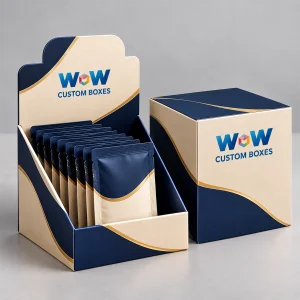
Custom Corrugated Displays That Support Retail Selling
Retail displays bring product, message, and shopper attention together in one structure. A well-designed unit makes stock easy to see, reach, replenish, and understand without demanding permanent store fixtures. Wow Custom Boxes can develop corrugated displays around the product dimensions, weight, quantity, placement, campaign duration, and retailer requirements. The resulting format can function as a countertop presenter, shelf tray, floor stand, sidekick, dump bin, or pallet-scale unit.
Unlike a standard shipping case, custom display boxes use structural and graphic surfaces to guide the shopping experience. A header can communicate a campaign message, side panels can reinforce benefits, and dividers can keep variants arranged. The best structure protects inventory during handling but opens or assembles quickly at the store. It also remains stable as products are removed, preventing a half-empty unit from leaning, collapsing, or hiding the remaining stock.
Choose the Correct Display Format
Countertop displays suit small, lightweight products placed near checkout, service desks, or category shelves. Shelf-ready trays organize units while reducing individual facing work. Floor displays create a freestanding branded zone and can hold several shelves, hooks, or product wells. Sidekicks attach to compatible fixtures and use narrow vertical space. Dump bins encourage browsing of flexible or individually packed goods. Pallet displays combine transport efficiency with a larger in-store footprint for high-volume promotions.
The structure should match how customers shop the category. Small beauty items benefit from ordered compartments and a clear tester or product hierarchy. Snack packs may need an open front and fast replenishment. Heavier bottles require supported shelves and conservative load assumptions. Experience with custom corrugated boxes helps translate product weight and distribution conditions into flute choice, wall construction, folds, tabs, reinforcements, and load paths.
Material and Flute Selection
Corrugated board uses liners around a fluted medium to create stiffness with relatively low weight. E, B, and other flute profiles offer different balances of print surface, thickness, cushioning, and strength. Single-wall board may suit many short-term displays, while double-wall or laminated components can support heavier goods or longer use. Some units combine corrugated structural parts with paperboard signs, plastic hooks, or separate shelves. Material selection should follow the actual load, span, store environment, and expected handling.
| Display type | Typical placement | Best for |
|---|---|---|
| Counter display | Checkout or service counter | Small packs, samples, impulse products |
| Shelf-ready tray | Existing retail shelf | Fast stocking and organized facings |
| Floor stand | Aisles and promotional zones | Multi-SKU campaigns and larger inventory |
| Dump bin | Open selling area | Loose, flexible, or mixed merchandise |
| Pallet display | Club and high-volume retail | Large promotions and efficient deployment |
Many brands coordinate the display with their unit-level cardboard packaging. Matching colors, typography, icons, and claims creates a clearer block at shelf. Dimensional planning is equally important: wells and shelf openings must fit the finished packs with enough tolerance for quick loading, but not so much space that products tip or face inconsistently. Product samples and accurate packed dimensions are essential inputs.
Structural Features That Improve Use
Headers increase vertical communication space without occupying the product well. Dividers separate flavors, shades, or sizes, while stepped platforms keep rear products visible. Reinforced shelf edges help resist bending, and hidden supports can transfer load into sidewalls. Tear-away shipping panels allow one pack to travel closed and convert into an open display. Hand holes aid movement when positioned and reinforced correctly. Locking tabs can speed assembly, though instructions should remain simple enough for store teams.
Display stability should be evaluated both full and partly empty. A high center of gravity, uneven product removal, narrow base, or forward-projecting shelves can increase tipping risk. Weight should travel through supported vertical panels rather than unsupported spans. Where hooks are used, the hook board and attachment area need reinforcement. Prototypes help reveal whether tabs release, shelves sag, graphics align, and employees can assemble the unit without special tools or improvised tape.
High-Impact Printing and Branding
Flexographic printing can provide efficient spot-color graphics directly on corrugated board. Litho-laminated surfaces support detailed images, gradients, small typography, and premium campaign artwork. Digital methods may suit shorter runs, regional versions, or rapid promotions. Matte, gloss, or protective coatings can alter appearance and scuff resistance. The print plan should account for folds, cut edges, product obstruction, viewing distance, and the difference between a flat production dieline and an assembled three-dimensional unit.
Messaging works best in layers. The header communicates one immediate idea, such as the product type, promotion, or core benefit. Side panels can add proof points or usage cues, and shelf lips can identify variants or prices. Dense paragraphs are difficult to read in busy aisles. Strong contrast, short phrases, recognizable product imagery, and consistent brand assets help the display communicate quickly while leaving the merchandise itself as the main focus.
Displays for Food, Beauty, and Wellness
For custom food packaging, corrugated displays can organize wrapped snacks, sachets, cartons, or takeaway accessories. Product contact, grease exposure, and store hygiene requirements should be addressed through the unit pack and appropriate materials. custom cereal boxes can be grouped in floor stands or shelf trays that highlight flavors and pack sizes while maintaining straight facings.
Beauty displays often need smaller cells, testers, shade organization, and premium graphics. Coordinating the structure with custom cosmetic boxes creates a unified launch presentation. Wellness promotions may use displays alongside custom CBD boxes, subject to all applicable product, advertising, retailer, and jurisdictional rules. In every category, claims and mandatory information should be supplied and approved by the responsible brand.
Design for Shipping and Store Setup
Some displays ship flat and assemble at the store; others are pre-packed and travel inside an outer case or on a pallet. Flat units reduce shipping volume but transfer more assembly work to retail staff. Pre-packed units can improve speed and product arrangement but require stronger transport protection. The design brief should state who assembles, where products are loaded, how the unit is moved, whether it travels through a distribution center, and how much time staff can reasonably spend on setup.
Short Campaigns and Ongoing Programs
A limited promotion may prioritize fast assembly, bold campaign graphics, and efficient material use. An ongoing display program may need replaceable headers, stronger shelves, replenishment access, and consistent dimensional standards across changing products. Version control matters when campaigns include multiple languages, prices, retailers, or regional claims. Clear artwork naming and approval processes reduce the chance that obsolete graphics reach stores.
Develop and Test the Display
Begin with packed product samples, quantity per unit, product weight, desired footprint, placement, retailer constraints, campaign duration, and logistics plan. Structural prototyping can check assembly, fit, stability, access, shelf deflection, and replenishment. A printed sample confirms color, message hierarchy, and artwork alignment. Distribution testing may be appropriate when a pre-packed unit must survive handling. Final specifications should include pack-out instructions and diagrams for consistent deployment.
Make Every Panel Work Harder
Custom corrugated displays succeed when structure and communication reinforce each other. Strong board alone will not correct a difficult loading process, and attractive graphics will not rescue an unstable unit. A practical footprint, clear message, organized product arrangement, and efficient setup create a display that serves both shoppers and store teams. With the product and route defined early, corrugated board can become a flexible, cost-conscious platform for memorable retail campaigns.
Frequently Asked Questions
What are corrugated displays?
They are lightweight retail merchandising structures made from fluted board and designed to organize products while carrying branded graphics.
Which display styles are available?
Options include countertop units, shelf-ready trays, floor stands, sidekicks, dump bins, pallet displays, and custom hybrid formats.
Can displays ship with products inside?
Yes, some structures are designed as pre-packed displays, but they require appropriate outer protection and distribution evaluation.
Can a corrugated display hold heavy products?
It may, provided board grade, shelf spans, reinforcements, base design, and load paths are engineered for the verified weight.
What printing methods can be used?
Common approaches include flexographic printing, litho-laminated graphics, and digital printing, depending on artwork and quantity.
Do floor displays require tools to assemble?
Many can use locking tabs and folds for tool-free setup, although the exact assembly method depends on size and load.
Can one display hold multiple products?
Yes. Dividers, shelves, hooks, and labeled wells can separate different flavors, shades, sizes, or related products.
Are prototypes available before production?
Prototypes can be used to evaluate product fit, loading, assembly, stability, graphics, and shopper access before the main run.
How are display dimensions determined?
Dimensions follow product size, quantity, placement, retailer limitations, loading method, stability, and transportation requirements.
What information is needed for pricing?
Provide product samples or dimensions, weight, units per display, style, footprint, artwork, quantity, assembly, and shipping plan.