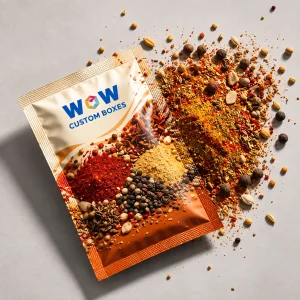
Product Detailed Description
Custom Instant Food Sachets for Convenience Products
Convenience foods are designed around easy preparation, simple handling, and practical serving sizes.
Instant Food Sachets support these characteristics by providing compact packaging for products that can be portioned and prepared when needed.
Dry meal mixes, soup preparations, seasoning combinations, powdered ingredients, instant cooking products, and other convenience foods can benefit from flexible sachet formats. The packaging can be developed around the desired quantity and product characteristics.
For food manufacturers, sachets can also simplify product segmentation. Different flavors, recipes, serving sizes, or product variations can use different printed designs while maintaining the same overall packaging system.
For related dry-food packaging,
dry food sachets offer another suitable format for portioned food products.
Materials Used for Instant Food Sachets
Instant food products can have different packaging requirements depending on moisture sensitivity, particle size, storage conditions, shelf-life objectives, and filling processes. Flexible laminated structures can combine different materials to meet these requirements.
PE is commonly useful as a sealing layer because it offers flexibility and heat-sealing properties. BOPP can provide a printable outer surface, while PET can add strength and dimensional stability.
Where stronger environmental protection is required, a barrier film can be incorporated into the structure. The correct construction should be determined by the product rather than selecting the same material combination for every food application.
| Material |
Purpose |
| PE |
Sealing and flexible inner layer |
| BOPP |
Printing and package appearance |
| PET |
Strength and stability |
| Barrier Film |
Additional product protection |
Applications of Instant Food Sachets
Instant food sachets can be used for soup mixes, powdered meal preparations, dry cooking ingredients, instant recipes, seasoning blends, beverage preparations, and other portion-controlled products.
Retail brands can use sachets for individual products or combine several sachets into a multipack. Foodservice businesses can use them for controlled portions, while promotional campaigns can distribute smaller samples.
Travel products can also benefit from the compact format. A single portion can be easier to carry than a larger container, especially when customers need convenience while traveling.
Brands that require stronger protection for specific food products can also review
high barrier sachets.
Custom Printing and Food Branding
Custom printing helps instant food brands communicate product identity directly through packaging. Artwork can include the product name, flavor, preparation instructions, serving information, brand identity, ingredient details, and promotional messaging.
Different products within the same range can use coordinated artwork. For example, soup varieties can use separate visual treatments while maintaining the same brand typography and design system.
This can improve product organization and help customers quickly distinguish between flavors and recipes.
For powdered food products,
powder sachets can also serve as a related packaging reference.
Portion Control and Convenience
One of the key advantages of sachet packaging is the ability to create defined portions. This can simplify preparation and reduce the need for customers to measure the product manually.
Portion packaging can also help businesses organize products for foodservice and promotional applications. Individual sachets can be distributed as needed without opening a larger package.
For food manufacturers, the format can support different product quantities without requiring a completely different packaging concept.
Benefits of Instant Food Sachets
Instant food sachets are lightweight, compact, and easy to organize. Their flexible construction can reduce packaging volume compared with some rigid formats, which may support efficient storage and transportation.
Custom printing provides another significant benefit. The package can become an important communication surface rather than simply serving as a container.
The format can also support samples and trial quantities, allowing brands to introduce new products without distributing full-size packages.
Pros and Cons
| Pros |
Cons |
| Compact and lightweight |
Not suitable for every food format |
| Convenient portion control |
Material selection is important |
| Large printable surface |
Seal performance requires attention |
| Suitable for samples |
Large-volume products may require other formats |
Packaging for Different Food Businesses
Food manufacturers, restaurants, catering businesses, meal brands, and promotional companies can all have different requirements for sachet packaging. A retail product may prioritize shelf appearance, while foodservice packaging may prioritize portion control and ease of handling.
Custom packaging allows these requirements to be addressed through dimensions, material selection, artwork, and packaging configuration.
Brands that sell snack products can also explore
snack sachets for other compact food applications.
Cost and Packaging Value
Instant food sachet pricing depends on material structure, dimensions, print requirements, production quantity, finishing, and packaging specifications. The quantity ordered can influence the economics of custom production.
Businesses should also consider the overall value created by the packaging. Efficient storage, product protection, convenience, branding, and portion control may justify a custom flexible format even when a simpler package has a lower initial unit cost.
Choosing the Right Sachet Structure
Before ordering, brands should evaluate product composition, moisture sensitivity, desired shelf life, fill weight, filling method, seal requirements, storage environment, and transportation conditions.
Packaging testing can help verify that the selected structure performs correctly throughout production and distribution. This is particularly important for food products where packaging performance directly affects product presentation and storage.
Additional Related Packaging
For culinary products,
spice sachets provide a related portion-packaging solution.
Seasoning-focused products can also use
seasoning sachets when the product requires a dedicated seasoning format.
Final Thoughts
Instant Food Sachets offer a practical combination of portability, portion control, branding, and flexible packaging performance. They are suitable for many dry and convenience food applications where compact packaging is valuable.
The best package should be developed around the actual food product, filling process, sealing requirements, storage conditions, and distribution environment. Proper material selection and professional printing can create a package that supports both product handling and market presentation.
Frequently Asked Questions
What are Instant Food Sachets?
They are flexible packages used for instant meals, dry mixes, powdered foods, seasonings, and portioned convenience products.
What products can use instant food sachets?
Suitable products include soup mixes, instant meal ingredients, dry mixes, powdered preparations, and seasoning products.
Can instant food sachets be custom printed?
Yes. Custom artwork can include branding, product information, preparation instructions, and graphics.
Are instant food sachets suitable for dry mixes?
Yes. Suitable flexible structures can be developed for many dry food mix applications.
What materials are used?
Possible structures include PE, BOPP, PET, and suitable barrier films.
Can sachets be made in different sizes?
Yes. Dimensions can be customized according to product quantity and filling requirements.
Are instant food sachets suitable for samples?
Yes. Small sachets can be used for trials, promotional products, and sampling campaigns.
Can seasoning products use this packaging?
Yes. Seasoning blends and powdered culinary ingredients can use appropriate sachet formats.
What affects food sachet material selection?
Product sensitivity, moisture exposure, shelf-life requirements, filling, sealing, storage, and transportation affect material selection.
Are instant food sachets suitable for retail?
Yes. They can be developed for retail portions, convenience foods, samples, and various packaged food products.