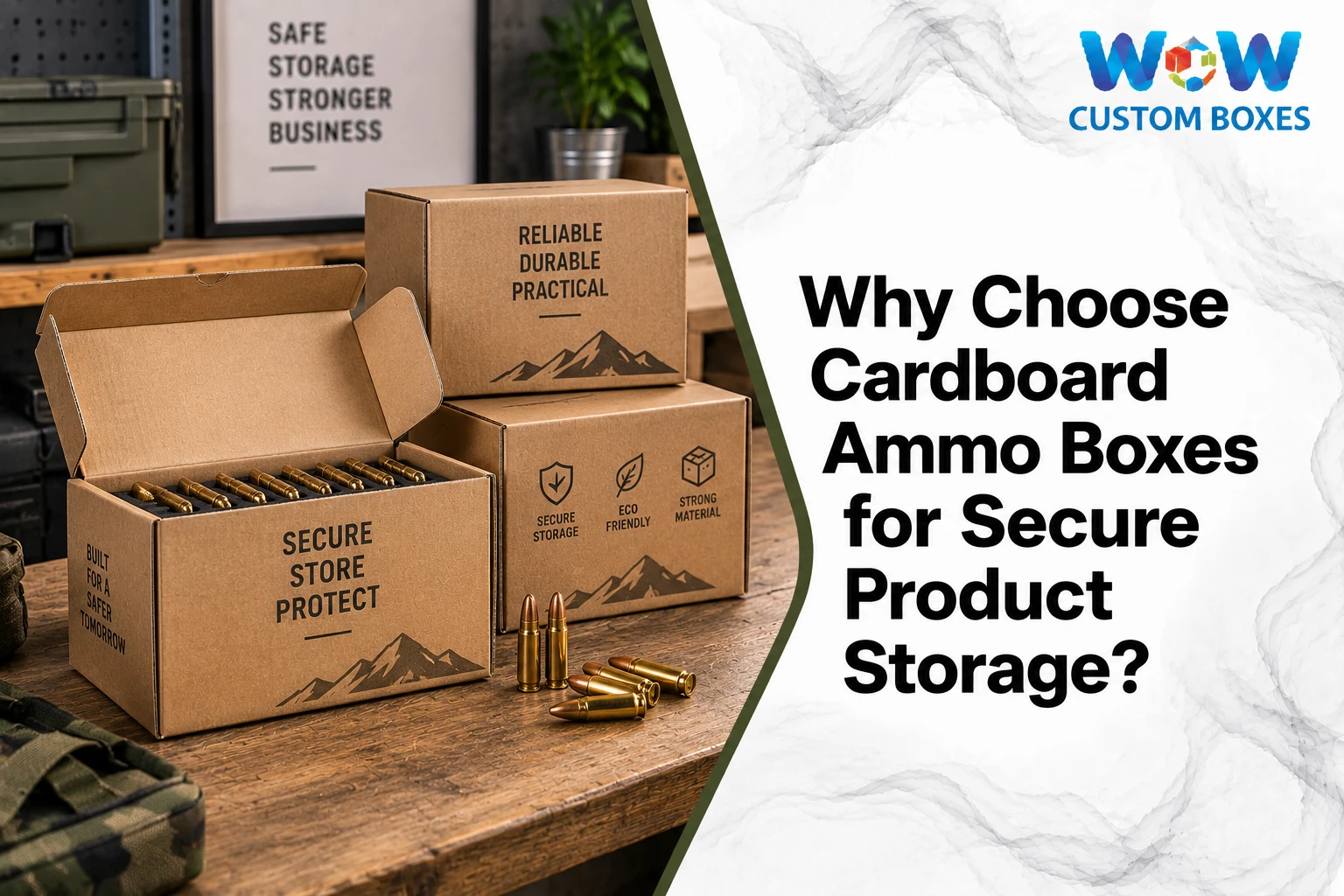
Cardboard ammo boxes are purpose-designed cardboard packaging structures that provide defined compartments or enclosed space for packaged products. Their rectangular format makes them easy to arrange, label, stack, transport, and store. Depending on the intended application, they may be produced from paperboard, corrugated board, or stronger multi-layer cardboard constructions.
Businesses can select custom cardboard ammo boxes according to product dimensions, quantity, required board strength, printing needs, and presentation preferences. Custom sizing is especially important because excessive empty space can reduce storage efficiency, while boxes that are too small may place unnecessary pressure on the packaged contents.
One of the main advantages of Cardboard Ammo Boxes is their ability to provide a defined package around products. Loose products can be more difficult to organize, identify, count, and protect. An appropriately sized box keeps items grouped together and creates a more manageable unit for storage.
The structure can also help reduce direct contact with dust, handling marks, surface scratches, and other everyday storage risks. While cardboard packaging should always be selected according to the specific product and applicable storage requirements, it can provide an effective secondary protective layer for many commercial packaging applications.
Cardboard Packaging is widely used because it combines relatively low weight with useful structural strength. It can be cut, folded, printed, labeled, and produced in different thicknesses. This allows businesses to select a packaging format according to how much support the product requires.
Cardboard also provides a flat printable surface for important information. Companies can add product names, identification codes, inventory references, handling information, barcodes, batch details, branding, and other required markings to the exterior of the box.
Protection depends on the board grade and structure selected. A properly designed cardboard box can create separation between the product and its surrounding storage environment. It can also help reduce product movement when dimensions are correctly matched.
For more demanding packaging situations, businesses may consider double wall cardboard boxes. Double-wall structures provide additional layers compared with simpler board formats and can be useful when greater compression resistance or stacking strength is required.
| Material | Suitable Application | Main Benefit |
|---|---|---|
| Paperboard | Lightweight packaged products | Easy folding and printing |
| Single-Wall Corrugated | General storage and packaging | Balanced strength and low weight |
| Double-Wall Corrugated | Heavier or stack-sensitive products | Greater structural support |
| Kraft Board | Natural-style commercial packaging | Strong, simple presentation |
| Coated Cardboard | Branded product presentation | Improved printing surface |
Not every storage application requires the heaviest possible board. Lightweight products and shorter storage cycles may work well with single wall cardboard boxes. Their lower material weight can make them practical when businesses need a balance between packaging efficiency and everyday structural protection.
The correct choice depends on product weight, stacking height, storage duration, handling frequency, and environmental conditions. Testing samples under realistic storage conditions can help determine whether a single-wall or stronger structure is more appropriate.
Good Storage Boxes do more than contain products. They help create an organized inventory system. Boxes with consistent dimensions can be placed more efficiently on warehouse shelves, storage racks, counters, or designated inventory areas.
Clear exterior labeling also makes products easier to identify without repeatedly opening every package. Businesses can organize boxes according to product type, item number, quantity, batch, destination, or other inventory categories.
Well-designed Cardboard Boxes can support organized stacking when the material, dimensions, product weight, and storage arrangement are suitable. Uniform boxes are generally easier to stack than irregular or loose packages because their flat surfaces create more predictable contact points.
However, businesses should not assume that every cardboard structure can support the same load. Stacking performance depends on board grade, flute construction, box dimensions, moisture exposure, product weight, and how long boxes remain stacked.
Correct sizing is one of the most important factors in packaging performance. Oversized Packaging Boxes can waste storage space and may allow products to shift unnecessarily. Undersized boxes can create excessive pressure or make closure difficult.
Businesses should measure the complete packaged product rather than estimating dimensions. Space may also be required for inserts, dividers, cushioning, documentation, or other packaging components.
Yes. Depending on the product, internal partitions or inserts can help separate individual items and reduce unwanted movement. Dividers may also make counting and organization easier because each item can have a defined position within the box.
The insert material and layout should be selected according to the product’s dimensions, weight, shape, and protection requirements. Custom internal structures are particularly useful when several small packaged products need to remain separated during storage or handling.
Correctly sized packaging can limit unnecessary movement inside the container. Products that shift excessively may contact one another or repeatedly strike the walls of the package during handling.
Using the right internal dimensions, partitions, or cushioning materials can improve stability. Businesses should avoid overpacking or compressing contents simply to reduce movement; the packaging configuration should be designed around the product.
Inventory management often depends on clear identification. Cardboard provides a convenient surface for printed information and adhesive labels. Businesses can include barcodes, stock numbers, product names, quantity information, handling instructions, dates, or tracking identifiers.
For warehouses managing many visually similar packages, clear labeling can reduce the amount of time employees spend identifying products. Consistent label placement can make scanning and manual stock checks more efficient.
Yes. Custom Printed Cardboard Boxes can combine storage functionality with branding and product identification. Printing can range from simple one-color information to more detailed graphics depending on the packaging requirements.
A business may print its logo, product category, handling information, identification markings, QR codes, batch details, or other relevant data directly onto the exterior. This can reduce dependence on separate labels while creating a more professional packaging appearance.
Cardboard packaging can work well in controlled warehouse environments when the correct material is selected. Consistent box dimensions can improve shelf organization and help businesses use available storage space more efficiently.
For businesses managing many stored products, dedicated cardboard storage boxes can also support structured inventory organization. The underlying principle is similar: products or materials are easier to manage when they have clearly defined containers and identification.
Different materials have different strengths. Plastic containers may be reusable and resistant to certain environmental conditions, while metal containers can provide significantly greater rigidity. Cardboard, however, offers advantages in weight, printability, customization, flat storage, and packaging flexibility.
| Feature | Cardboard | Plastic | Metal |
|---|---|---|---|
| Weight | Lightweight | Light to moderate | Usually heavier |
| Printability | High | Varies | Requires specialized methods |
| Custom Sizing | Highly flexible | Often mold-dependent | More complex |
| Flat Storage | Often possible | Usually limited | Usually limited |
| Structural Strength | Varies by board grade | Varies by design | Generally high |
Cost-effectiveness depends on dimensions, board grade, printing, order quantity, inserts, finishing, and required performance. Cardboard can be economical because the material is lightweight and packaging can often be supplied flat before assembly.
Businesses should evaluate total packaging performance rather than selecting the lowest unit price. A poorly designed box that fails during handling, wastes warehouse space, or requires frequent replacement may create higher operational costs.
Yes. Cardboard Ammo Boxes Bulk purchasing can be useful for companies with regular and predictable packaging requirements. Larger orders can help businesses maintain consistent dimensions, materials, printing, and inventory availability.
Before placing a bulk order, businesses should confirm product dimensions and test samples. This reduces the risk of receiving a large quantity of boxes that do not properly fit the intended products or storage environment.
Cardboard Ammo Boxes Wholesale can make sense for high-volume operations that repeatedly use the same packaging specifications. Wholesale purchasing allows businesses to plan packaging inventory alongside product inventory rather than sourcing containers only when immediate needs arise.
Companies should consider available storage space before purchasing large quantities. Flat-packed designs can help reduce the footprint of unused packaging until boxes are required.
Material strength should match the intended application. A box used for lightweight products on a low warehouse shelf may have very different requirements from one used for heavier products or higher stacking arrangements.
Board thickness alone does not determine performance. Box design, flute profile, dimensions, closure construction, storage conditions, and load distribution can all influence structural strength.
Yes. Secure storage does not mean packaging has to look generic. Businesses can combine functional design with branded printing to create packaging that is organized, identifiable, and visually consistent.
Brand colors, logos, product information, typography, and identification codes can all be incorporated into the box design. This is particularly useful when packaged products move between warehouses, distributors, retailers, or business locations.
Cardboard packaging can offer material-efficiency advantages because structures can be designed closely around the packaged product. Correct sizing helps reduce unnecessary material and can also decrease unused space during storage.
Businesses interested in environmental performance should consider material sourcing, recycled content, recyclability, coatings, inks, adhesives, and the complete packaging system rather than relying on a single environmental claim.
The main benefit of Cardboard Ammo Boxes is their combination of organization, customization, lightweight handling, printability, and structural flexibility. Businesses can select box dimensions and material specifications according to the products they need to contain and the conditions in which those products will be stored.
They can provide a clear storage location for packaged products, support inventory labeling, improve shelf organization, and help protect contents from routine handling and surface exposure. Stronger cardboard constructions can be selected when greater stacking or structural performance is required.
Choosing suitable packaging is essential for organized and secure product storage. Cardboard Ammo Boxes offer businesses a customizable option that can combine structural protection, clear identification, efficient stacking, and branded presentation.
Before ordering, businesses should evaluate dimensions, product weight, material strength, storage environment, printing, inserts, stacking requirements, and order volume. Packaging for regulated or sensitive products should also follow all applicable manufacturer, storage, transport, and legal requirements. To discuss box dimensions, cardboard grades, printing options, or bulk quantities, Contact Us for packaging assistance.
Cardboard ammo boxes are structured cardboard packaging designed to provide organized containment, labeling space, and protective packaging for appropriate products.
Cardboard boxes are lightweight, customizable, printable, stackable, and available in different strength levels for a variety of storage applications.
Their strength depends on the board grade, construction, dimensions, product weight, stacking arrangement, and environmental conditions.
Yes. Custom dimensions can be selected to match the product and reduce unnecessary internal space.
Yes. Internal partitions and inserts can be used when products need separation, organization, or additional stability.