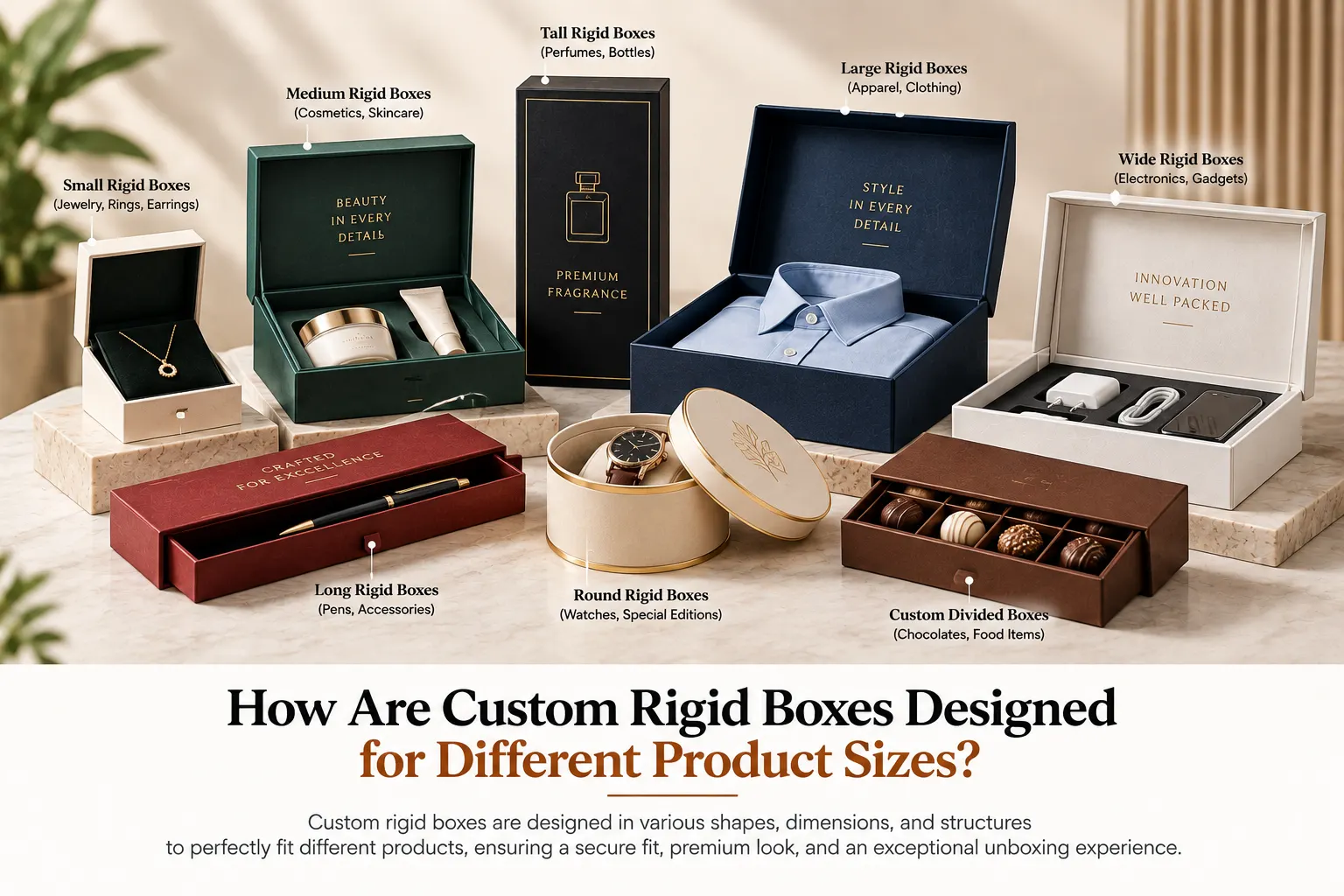
The design process normally starts with accurate product measurements. Length, width, height, diameter, weight, and any additional components should be considered before the box structure is finalized. The outer dimensions are then developed around the required internal space and construction. Businesses can review Custom Packaging options when comparing different structures and deciding which features are suitable for their products.
Product size is one of the first factors considered when developing a rigid box because the package must accommodate the item comfortably. A box that is too small can make product placement difficult, while an oversized box can leave too much empty space around the product. Neither situation creates an ideal presentation. A suitable fit allows the product to sit properly while leaving enough room for an insert, protective material, or accessories when required.
Businesses should measure the product in its final selling condition. If a bottle has a cap, the cap height should be included. If an electronic product comes with a charger or cable, those components should also be considered if they will be packed together. Accurate measurements make it easier to determine the internal dimensions before the outer structure is produced.
Medium-sized products such as watches, perfume bottles, candles, and cosmetic collections can require more internal space while still needing a controlled product fit. These products may use inserts to provide support and organization. The insert should be designed according to the product dimensions rather than using a generic interior that leaves excessive space around the item.
The box structure should also provide enough room for comfortable product removal. If the product is difficult to take out because the interior is too tight, the customer experience can suffer. Businesses should test the actual product inside the sample before approving final production. This allows them to check the fit, opening method, and overall proportions.
Larger products and gift sets can require wider, deeper, or taller rigid boxes. When several products are placed together, the interior can use compartments or inserts so each item has a defined position. This creates a more organized presentation and prevents products from moving around inside a large empty space.
Weight becomes particularly important with larger packages. Several products combined in one box can create more weight than a single item, so the structure should be selected accordingly. The base, sides, lid, and internal support should work together to handle the complete product arrangement. Businesses should test the finished package with all products inside rather than checking only the empty box.
Inserts provide a way to customize the inside of the box around the product. They can create dedicated spaces for individual items, separate accessories, and help keep products in a controlled position. This can be especially useful for products with unusual shapes or collections containing several different items.
The insert can be designed independently from the outer box while still matching its dimensions. This gives businesses greater flexibility when packaging products that have different shapes. For example, one outer box can contain several products when the insert creates the correct internal arrangement. The insert should be measured together with the product so the complete interior remains practical.
Yes. Different products can use different structures according to their dimensions, weight, presentation requirements, and intended customer experience. A simple lid-and-base box can work well for one product, while a drawer structure may suit another. Compartment boxes can be useful for gift collections, and magnetic closures can provide a different opening experience for premium products.
The structure should solve a practical packaging requirement instead of being selected only because it looks unusual. For products that need a sliding opening, businesses can explore Rigid Drawer Boxes. The dimensions of the tray and sleeve can then be developed around the product that will be placed inside.
Product weight can influence the construction of the package as well as its dimensions. A lightweight product may work with a simpler specification, while a heavier product may require stronger board or additional internal support. Weight distribution should also be considered when several products are placed inside one box. A package should remain stable when it is lifted, opened, stored, and handled.
Businesses should provide accurate product weight information when planning the box. This helps determine whether the selected structure is suitable for the intended product. The internal support should also be tested with the actual item because the weight and shape of the product work together to affect the finished package.
Perfume bottles can have different heights, widths, shapes, caps, and weights, so fragrance packaging needs to be designed around the specific bottle. The insert can provide a dedicated space around the container, while the outer box can be sized to create a balanced presentation. This becomes especially useful when the bottle is made from glass or has an unusual shape.
The exterior can then carry the fragrance name, logo, collection details, and artwork. Businesses can maintain the same visual identity across several fragrances while adjusting the physical dimensions for each bottle. Options such as Rigid Perfume Boxes can be considered when the product requires a more structured presentation.
Perfume inserts can help create a defined space around the bottle and keep it positioned inside the box. The dimensions of the insert should reflect the actual bottle, including its cap and other components that will be packaged with it. The insert should provide support without making it difficult for customers to remove the bottle.
Different fragrance bottles may require different internal arrangements even when they belong to the same brand. One bottle may be tall and narrow, while another may be short and wide. The outer packaging can maintain consistent branding while the internal structure changes according to the product. Businesses can review Perfume Boxes With Inserts when planning a fitted interior for fragrance products.
Watches normally require a dedicated holder because the product has a specific shape and needs to remain positioned inside the box. The watch dimensions, strap size, accessories, and documentation should be considered when planning the interior. A single-watch box may need less space than a larger package containing multiple watches or additional components.
The outer box should provide enough room for the holder without becoming unnecessarily large. The lid should also close properly around the interior structure. Businesses can use Luxury Watch Boxes as an example of how product-specific packaging can combine a structured exterior with an organized interior.
Cosmetic products can vary significantly in size and shape. A single cream jar needs a different internal arrangement from a collection containing several cosmetic products. When several items are sold together, compartments can separate the products and create a more organized presentation. The box can also be designed with enough room for product labels, accessories, or promotional inserts.
The exterior dimensions should remain proportional to the complete cosmetic collection. A box that is much larger than its contents may look inefficient, while a box that is too compact can make product placement difficult. Businesses can review Makeup Cream Boxes when developing packaging around smaller cosmetic products and their specific dimensions.
Not every product has a simple rectangular shape. Bottles, jars, accessories, and specialty products can have curved, narrow, wide, or irregular forms. In these situations, the interior can be customized with a shaped insert while the outer box maintains a clean structure. This can provide a practical solution without making the entire exterior unnecessarily complicated.
The shape of the product should be considered from every angle. Height, width, corners, curves, caps, handles, and other protruding parts can affect the internal space. A physical sample is particularly useful for unusual products because it allows the business to check whether the item fits comfortably before approving production.
Businesses with several product sizes do not need to use identical packaging dimensions to create a consistent brand appearance. They can maintain the same logo position, typography, color palette, and design style while changing the physical size of each box. This creates a recognizable packaging family while allowing every product to receive a suitable fit.
For example, a small cosmetic product can use a compact box while a larger gift collection uses a wider structure. The physical dimensions are different, but the visual identity can remain consistent. This approach allows businesses to expand their product range without losing the connection between individual packages.
A sample allows businesses to confirm whether the selected dimensions work with the actual product. The product should be placed inside the sample so the business can check the fit, insert position, lid alignment, drawer movement, and ease of removal. The sample also provides an opportunity to review the printed artwork and finishing before larger production begins.
Testing becomes even more important when a product has unusual dimensions or multiple components. A flat artwork file cannot always show how the finished package will behave when assembled. A physical sample gives businesses a clearer understanding of the complete packaging experience and allows necessary changes to be made before a larger order.
Businesses should measure the product length, width, height, diameter, and weight before requesting final box dimensions. They should also measure any lids, caps, accessories, cables, documentation, or other components that will be placed inside the package. If an insert is required, the insert dimensions should be considered as part of the complete interior.
It is also useful to provide product photographs or a physical sample when the item has an unusual shape. Clear information makes it easier to plan the box structure and reduces uncertainty during production. The more accurate the initial measurements are, the easier it becomes to create packaging that fits the product correctly.
Yes. Rigid boxes can be produced according to specific product dimensions, shapes, weights, and presentation requirements. Businesses can adjust the outer dimensions, internal space, inserts, compartments, and opening structure according to the product they need to package.
This flexibility allows a brand to use different box sizes for different products while keeping its visual identity consistent. The physical structure can change when necessary without requiring the business to abandon its established branding.
The right box size starts with accurate product measurements and a clear understanding of how the product will be presented. Businesses should identify the required internal space, determine whether an insert is necessary, and select a structure that allows the product to be placed and removed comfortably. They should also consider product weight and the conditions under which the package will be stored or transported.
The goal is not simply to create the smallest possible box. The package should provide an appropriate fit, support the product, and maintain a balanced appearance. Testing the actual product inside a sample is one of the most useful steps for confirming that the dimensions work before production.
Different products deserve packaging that reflects their actual dimensions and requirements. Small items may need compact structures and fitted interiors, while larger products and gift sets may require deeper boxes, stronger construction, and multiple compartments. Accurate measurements, suitable materials, and careful sample testing can help businesses create packaging that looks professional and works properly.
If you are planning packaging for perfumes, watches, cosmetics, jewelry, gifts, or other products, you can Contact Us to discuss suitable dimensions, structures, inserts, materials, printing, and finishing options.
Yes. Rigid boxes can be produced in compact dimensions for jewelry, accessories, cosmetics, and other small products. Inserts can also be added when the item needs a dedicated position inside the package.
Yes. Larger products can use wider, deeper, or taller structures according to their dimensions and weight. Additional internal support can also be included when required.
Yes. Businesses can use different physical dimensions for different products while keeping consistent branding across the packaging collection.
Yes. Inserts can be developed around the shape, size, and arrangement of individual products. They can create dedicated spaces and improve internal organization.
Yes. A physical sample can be used to check product fit, insert placement, dimensions, opening functionality, and overall presentation before a larger production order is approved.