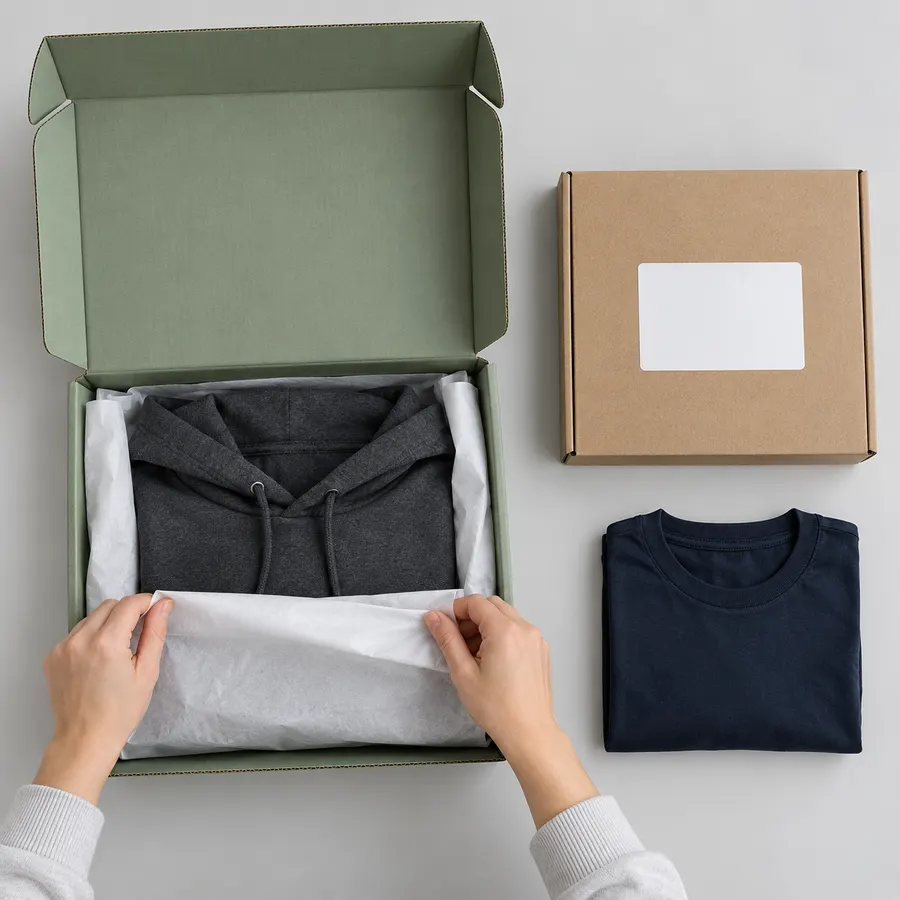
For many ecommerce clothing orders, a properly specified corrugated mailer is a useful starting point. It can combine a shipping structure, a manageable packing process, and printable surfaces in one package. That does not make one mailer style the best choice for every clothing brand. Lightweight basics, structured garments, gift sets, and mixed orders have different needs. Some products suit a retail carton inside an outer shipper; others need inserts or a separate presentation layer. The best apparel box is the one that fits your typical order, holds its closure during the intended journey, and works efficiently in your fulfillment process. This guide focuses on those operational choices, from folding the garment to preparing a return.
Start with your order mix rather than your largest product alone. Review whether customers usually buy one garment, several similar items, or mixed baskets. A single T-shirt order may not need the same carton as a hoodie and trousers. Measure representative garments in the fold used by your packing team. Include tissue, garment protection, cards, and any accessories. Create a small set of order profiles, such as single lightweight item, bulky item, and multi-item order. Then check whether a practical group of box sizes can cover them without excessive empty space. A custom clothing box specification should describe the packed order, not just the dimensions of an unfolded garment.
A corrugated mailer can be designed with a hinged lid and locking features that support product access and closing. Its suitability depends on board grade, dimensions, packed weight, closure, and the expected handling route. A familiar mailer shape does not prove that a particular specification is adequate. When reviewing custom mailer boxes, ask how the proposed package should be sealed and where the shipping label will go. Check the filled box for bulging and loose panels. Have the packing team open and close the sample using the intended tape or security feature. The aim is a repeatable shipping package that looks orderly when it reaches the customer.
A folding carton can organize an apparel product and support consistent presentation. It may be useful when the same item is sold online and in stores. However, a retail carton often needs a separate shipping package. Include that outer carton, label, sealing material, and cushioning when comparing alternatives. Custom cardboard boxes can serve the inner presentation role when their construction suits the garment. Decide where the retail package ends and the shipping protection begins. This distinction helps avoid approving an attractive carton that becomes difficult to deliver without damage.
Rigid packaging can suit occasion wear, premium gift orders, or carefully arranged apparel sets. It may create a structured opening sequence and keep the contents visually organized. Its assembled volume can also increase storage requirements. A separate outer shipper may make the parcel larger than an equivalent direct-mailer order. Review custom rigid boxes for specific order types rather than automatically applying them to every sale. A brand can keep a consistent identity across standard and premium packages through shared colors, typography, and logo placement. Every order does not need the same construction.
Too many carton sizes can complicate stock control. Too few can cause repeated overpacking. Test a shortlist against actual orders, including the largest apparel sizes and thickest seasonal fabrics. Check each order profile with its complete protective materials. Confirm internal dimensions for garment fit and external parcel dimensions for delivery planning. Where a carrier uses dimensional weight, review its current rules for the intended service.
Allow enough room to pack and remove the garment without forcing it. Avoid adding large gaps simply to make one oversized carton cover the entire range.
| Order type | Packaging direction to assess | Main approval check |
|---|---|---|
| Single folded garment | Compact corrugated mailer | Fit and closure without compression |
| Bulky hoodie or knitwear | Deeper mailer or shipping carton | Height and lid pressure |
| Several garments | Larger divided or organized package | Movement and loading sequence |
| Gift apparel set | Presentation pack with outer shipper | Complete parcel size and protection |
| Structured item | Product-specific support | Shape retention during handling |
Have staff pack several sample orders and record the steps. Can they identify the correct carton quickly? Does assembly require several adjustments? Can they close the package without refolding the garment? Review how tissue, stickers, inserts, and cards are stored at the packing station. A component that looks attractive in a mockup may be awkward to handle repeatedly. Compare observed packing time using the same order types. Include the time required to assemble the carton and apply any sealing materials. A clear packing instruction with photographs can help new team members reproduce the approved arrangement.
Leave a suitable, uninterrupted area for the shipping label. Check the actual label size and placement before committing to the print layout. Avoid positioning the label across an opening flap if that makes the intended customer experience difficult. If sealing tape crosses the branding, review whether the final package still communicates clearly. An opening feature should be understandable and appropriate for the structure. Test it with customers or staff who have not seen the design before.
The first successful opening matters more than a complicated mechanism that requires instructions.
Clothing orders may be returned because of fit or preference, even when the packaging works properly. Consider whether customers can reuse the carton and how they should reseal it. A second seal, reusable closure, or clear return instructions may help when included in the approved design. Check the carton after the first opening. Does it remain usable? Is there a suitable place for a new label? Do not promise repeated reuse without checking the structure. The condition of the returned carton and the return journey still matter.
Use representative garments and the complete parcel arrangement for approval. Inspect assembly, garment movement, closure, labels, and opening. Where shipping performance matters, agree on an appropriate test plan for the intended route and load. Review complaints after launch. Separate product damage, packaging damage, packing mistakes, and size-related issues so the response addresses the actual problem. WOW Custom Boxes provides options that can be discussed around these order profiles and fulfillment requirements. For a clear proposal, contact the packaging team with typical basket sizes, folded garment measurements, packed weight, artwork, quantity, destination, and required date.
A suitable corrugated mailer is often worth assessing for direct shipping. Its final dimensions, grade, and closure must match the packed order.
Yes. They can form part of the packaging system, but may require a protective outer shipper.
Yes. When stock sizes do not provide a suitable fit. Custom sizing should be compared against cost and operational requirements.
Use the smallest practical range that covers representative orders without consistent overpacking. Test this against actual order data.
Yes. If its capacity, structure, and internal arrangement suit the complete load without excessive movement or compression.