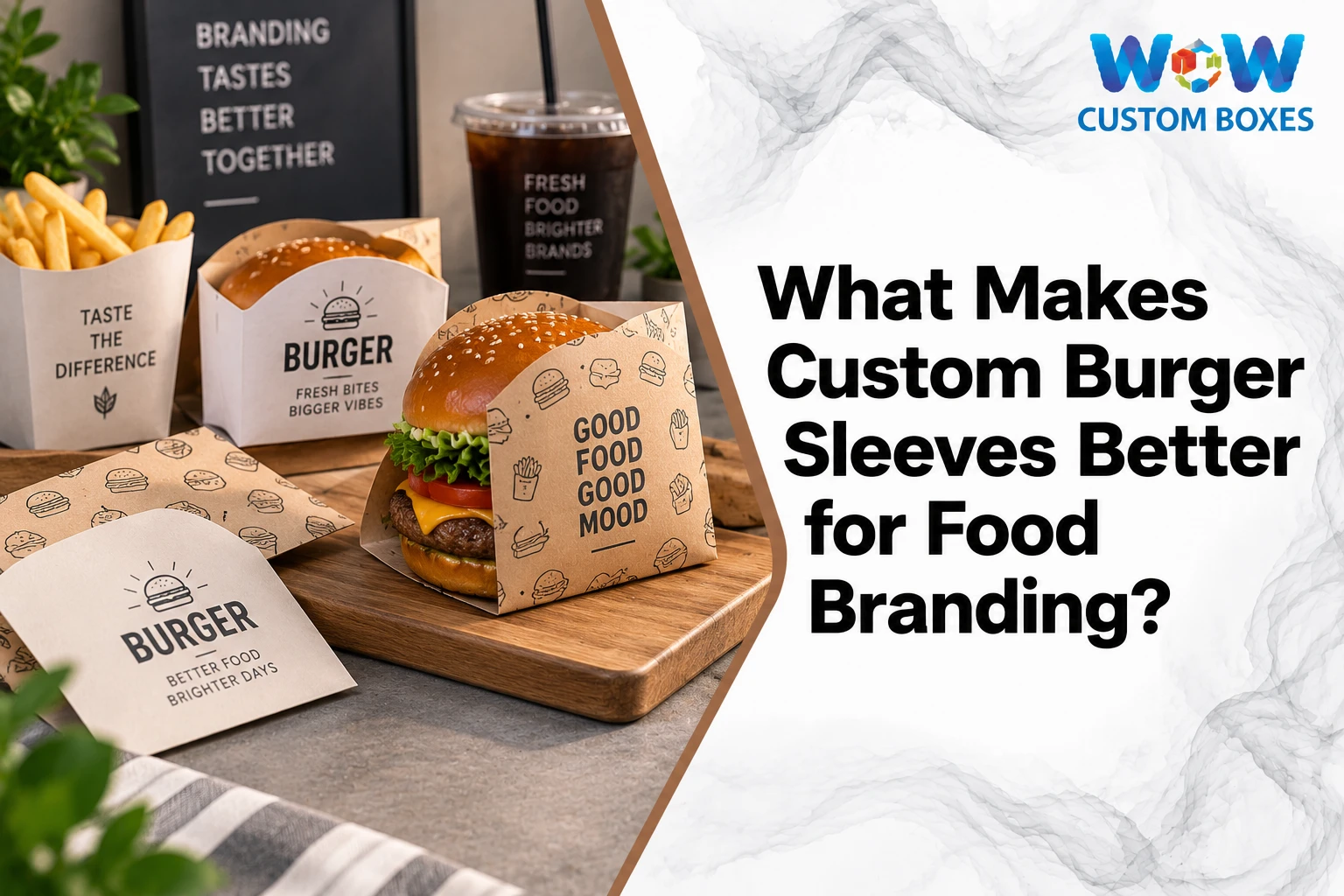
Custom burger sleeves are paperboard or food-grade packaging structures designed to partially wrap or hold burgers while leaving them convenient to eat. Unlike a fully enclosed burger box, a sleeve can provide a compact presentation with less packaging material while still giving restaurants an area for printing and branding.
Purpose-designed custom burger sleeves can be adapted according to burger dimensions, restaurant branding, material preferences, and serving requirements. They can be useful for dine-in orders, takeaway meals, food trucks, festivals, catering services, and quick-service restaurants.
Food branding helps customers recognize one restaurant from another. A burger may be similar in shape to products sold by competing restaurants, but the packaging surrounding it provides an opportunity to make the presentation distinctive. Brand colors, recognizable fonts, logos, slogans, and visual patterns can turn simple Burger Packaging into a marketing touchpoint.
When customers repeatedly see the same branding across packaging, menus, restaurant interiors, websites, and delivery orders, the overall identity can feel more consistent. Burger sleeves provide a compact surface where this branding can be placed directly around the product.
Generic food packaging does little to communicate who prepared the meal. Custom sleeves, by contrast, can display the restaurant’s visual identity directly on the product being served. This can help customers connect the burger with the business that made it.
Restaurants wanting stronger visual impact can use custom printed burger sleeves for logos, brand colors, product names, promotional graphics, social media handles, QR codes, or short marketing messages.
Consistent printing can be especially valuable for businesses with multiple locations. Customers can receive a similar branded presentation whether they order from one branch or another, helping maintain visual consistency across the brand.
A burger sleeve offers enough visible space for important branding without overwhelming the food presentation. The exact design should depend on the restaurant’s identity and target audience.
The design should remain readable even when the sleeve is wrapped around the burger. Restaurants should therefore prioritize strong visual hierarchy rather than trying to place too much information on a relatively small packaging surface.
For branding purposes, customized sleeves usually provide more marketing value than completely plain packaging. Plain paper or generic food containers can perform the basic function of holding food, but they do not communicate much about the restaurant.
Branded sleeves combine food presentation with visual communication. Customers see the restaurant identity while holding and eating the burger, creating repeated brand exposure during the meal.
Yes. One of the main advantages of Custom Food Packaging is its flexibility. Burger sleeves do not have to follow a single visual style. A premium restaurant may prefer minimal typography and subtle graphics, while a fast-food brand may choose bold colors and high-energy illustrations.
Businesses seeking a more natural presentation can consider kraft burger sleeves. Kraft-style packaging can complement restaurants that use earthy, rustic, handmade, or minimalist visual themes while still providing space for branded printing.
Material selection affects appearance, handling, print quality, and overall packaging performance. Restaurants should consider the type of burger being served, serving time, grease exposure, and intended brand appearance before choosing a material.
| Material | Best For | Branding Benefit |
|---|---|---|
| Kraft Paperboard | Casual and natural-style restaurants | Creates an organic, rustic appearance |
| White Paperboard | Colorful custom printing | Provides a clean printing surface |
| Coated Paperboard | Detailed branded designs | Supports polished graphics |
| Food-Grade Paper | Direct food presentation | Lightweight and practical |
A white surface can provide a neutral background for logos, illustrations, product photography-style graphics, or strong brand colors. Businesses with bright or detailed visual identities may prefer white material because printed colors can stand out clearly against the lighter background.
For this type of presentation, white burger wrap sleeves can be suitable for restaurants that want a clean base for customized branding while maintaining a simple food-serving format.
Presentation influences how customers perceive a meal before they taste it. A burger wrapped neatly in branded packaging can look more intentional than one presented in generic paper. The sleeve keeps the branding close to the product and can help create a more organized visual presentation.
For dine-in restaurants, this can improve tray presentation. In the takeaway businesses, it helps keep the food presentation recognizable even after it leaves the restaurant. For delivery orders, consistent branded packaging can help maintain the restaurant’s identity outside its physical location.
Burger sleeves can also provide a practical handling benefit. Burgers often contain sauces, cheese, oils, and other ingredients that can make them difficult to hold cleanly. A properly sized sleeve provides customers with a barrier between their hands and part of the burger.
The sleeve can also help hold ingredients together while the burger is being eaten. This does not eliminate the need for suitable food-grade materials, but it can make the overall eating experience more convenient.
Burger Boxes fully surround the product, while burger sleeves typically cover only part of it. Both formats serve useful purposes, but their ideal applications can differ.
| Feature | Burger Sleeves | Burger Boxes |
|---|---|---|
| Packaging Structure | Partial wrap or holder | Fully enclosed box |
| Serving Style | Direct eating and quick service | Takeaway and delivery |
| Branding Surface | Compact visible area | Larger printing area |
| Material Use | Generally compact | Uses a larger board structure |
| Product Access | Immediate | Requires opening |
Restaurants do not necessarily have to choose only one format. A burger sleeve may be used for dine-in or immediate consumption, while enclosed packaging can be used for takeaway and longer transportation.
Yes. Packaging can be changed for limited-time campaigns, seasonal menus, product launches, collaborations, or promotional events. A restaurant launching a new signature burger could print the product name or promotional message directly onto the sleeve.
Brands can also incorporate QR codes that direct customers to online menus, loyalty programs, social media profiles, review pages, or promotional landing pages. This allows physical Food Packaging to connect with digital marketing.
Food photography is common across social platforms. Customers often photograph meals before eating them, especially when packaging and presentation are visually appealing. When the restaurant name or logo appears clearly on the burger sleeve, customer-generated photos may naturally include the branding.
For this reason, restaurants should think about how sleeve artwork looks both in person and in photographs. Simple, recognizable designs may remain easier to identify when images are viewed on smaller phone screens.
Consistency is important for businesses building recognizable food brands. Customers should ideally experience similar visual branding across dine-in meals, takeaway orders, online deliveries, menus, bags, and other packaging.
Burger sleeves can act as one component of that broader packaging system. When colors, logos, fonts, and messaging are coordinated with other Restaurant Packaging, customers receive a more unified brand experience.
Burger sleeves are not only useful for large fast-food brands. Independent restaurants, cafés, food trucks, pop-up kitchens, and local takeaway businesses can also benefit from branded packaging.
Smaller businesses may use simple logo-based designs rather than complex graphics. Even a clean sleeve containing the restaurant name and recognizable brand color can make a meal look more professional than generic packaging.
Restaurants should select sleeves based on actual product dimensions rather than appearance alone. A sleeve that is too tight may be difficult to use, while one that is too large may not hold the burger securely.
Testing the sleeve with the actual burger before committing to a large production quantity can help restaurants confirm fit, handling, appearance, and print placement.
The Best Custom Burger Sleeves balance branding with practical food service. They should fit the burger correctly, provide enough structural support for convenient handling, use appropriate materials, and display branding clearly.
A visually impressive sleeve that performs poorly during serving will not provide the desired customer experience. Likewise, a functional sleeve with no recognizable branding may miss an opportunity to strengthen the restaurant’s identity. Successful packaging combines both qualities.
Custom burger sleeves place the restaurant’s identity directly around one of its most important products. They create repeated brand visibility, support product presentation, offer space for marketing messages, and can make takeaway or dine-in meals feel more distinctive.
They are particularly useful for businesses that want their Burger Packaging to communicate more than basic functionality. With carefully selected materials, printing, dimensions, and graphics, a simple sleeve can become part of a broader restaurant branding strategy.
Custom burger sleeves combine practical food handling with an opportunity to promote restaurant identity. From logos and brand colors to promotional graphics and QR codes, sleeves can turn everyday burger packaging into a recognizable part of the customer experience.
Restaurants considering branded burger packaging should focus on product fit, material quality, food suitability, printing, and consistent visual design. To discuss sizes, printing options, materials, or quantities for your restaurant, Contact Us for custom packaging assistance.
Custom burger sleeves are food packaging structures designed to partially wrap or hold burgers while providing space for logos, colors, text, and other restaurant branding.
Yes. They place branding directly around the food, helping restaurants create a more recognizable and consistent presentation.
Yes. Burger sleeves can be printed with logos, restaurant names, brand colors, slogans, product information, promotional messages, and other graphics.
The appropriate material depends on the burger, grease exposure, desired appearance, printing requirements, and restaurant serving style.
Yes. They can be useful for takeaway and quick-service applications, although additional outer packaging may be required depending on transportation needs.