| Specifications |
Details |
| Dimension (L + W + H) |
All Custom Sizes & Unique Shapes |
| Quantities |
Minimum Order Quantity is 500 Pieces |
| Paper Stock |
BoPET (biaxially-oriented polyethylene terephthalate) film,
89 µ to 178 µ (or 3.5 mils up to 7 mils)
|
| Printing |
No Printing, CMYK, CMYK + 1 PMS color, CMYK + 2 PMS colors |
| Finishing |
Gloss Lamination, Matte Lamination, Gloss AQ, Gloss UV, Matte UV, Spot UV, Embossing, Foiling |
| Included Options |
Die Cutting, Gluing, Scoring, Perforation |
| Additional Options |
Zipper, Hanging holes, Tear Notch,
stand-up feature, child-resistant lock
|
| Proof |
Flat View, 3D Mock-up, Physical Sampling (On request) |
| Turnaround |
7 - 10 Business Days |
Product Description
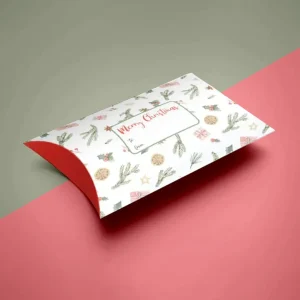
Create compact retail, gift, favor, and accessory packaging with custom cardboard pillow boxes from WOW Custom Boxes. We match the curved body, end-flap closure, board stiffness, dimensions, and print layout to the product and packing process. Choose white, natural, colored, or specialty paperboard with logos, patterns, coatings, foil, embossing, windows, or ribbon details. Formed samples help confirm score quality, product fit, closure tension, and presentation before bulk production.
Product Detailed Description
Cardboard Pillow Boxes Engineered for Curved Presentation
Cardboard Pillow Boxes use scored paperboard to create a compact, curved carton with distinctive end flaps. This page focuses on the material and structural decisions that help the pillow form open, load, close, display, and store consistently. Wow Custom Boxes can coordinate dimensions, board grade, grain direction, print, finishing, and packing details around the named product, while final suitability depends on the approved specification and physical sample.
Paperboard stiffness, controlled curves, score quality, product fit, and printable surface define this page. General pillow packaging spans multiple materials and applications, while candy and Christmas pages answer product- or occasion-specific needs. Measure the item, identify the handling route, and decide whether the carton is a retail pack, gift pack, favor, or inner presentation unit. Review custom pillow boxes when cardboard is not the central buying requirement.
Cardboard Pillow Boxes Specification Options
Use this table as a planning reference. The approved dieline, named paperboard, representative sample, and final proof remain the production controls.
Cardboard pillow packaging planning guide
| Specification |
Available direction |
Decision purpose |
| Product fit |
Measured product, wrap, insert, and clearance |
Supports loading and closure |
| Board |
White, kraft, colored, or specialty paperboard |
Balances stiffness and forming |
| Grain and scores |
Set for the approved curved structure |
Controls bending and cracking |
| Closure |
Curved end flaps with optional seal |
Supports access and containment |
| Print |
One-color, process, inside, or outside artwork |
Builds product recognition |
| Finish |
Coating, foil, embossing, debossing, or window |
Adds selected visual detail |
Measure the Item and Working Clearance
Custom Cardboard Pillow Boxes should be developed around the complete packed item. Include tissue, inner bag, instruction card, small insert, protective wrap, or ribbon in the measurement. Record the widest, deepest, and tallest points, packed weight, orientation, and any area that should not carry pressure. The carton changes shape when the curved ends close, so a simple rectangular volume calculation is not enough.
Build only the clearance needed for loading, normal production variation, and safe removal. Too much space allows movement and weakens presentation; too little can bow the body or reopen the flaps. Coordinate related formats through custom packaging boxes, but approve the final footprint and body depth with a formed sample.
Select Cardboard That Forms Without Failure
Cardboard Gift Pillow Boxes depend on the interaction between caliper, stiffness, flexibility, grain direction, moisture, surface treatment, and score geometry. A rigid board may look substantial while flat but resist the intended curve. A very flexible sheet may form easily yet feel weak with a heavier item. Specify the actual board rather than relying only on broad terms such as cardboard or paperboard.
Test for score cracking, fiber exposure, spring-back, delamination, edge damage, and panel distortion after forming. For a wider view of printed folding-board constructions, compare custom cardboard boxes. Material changes should trigger a new forming and fit review.
Coordinate Grain Direction and Scoring
The pillow shape is produced by designed creases and curved end scores. Grain direction affects how the blank bends and whether printed or coated surfaces crack. Tooling should create clean folds without cutting through the sheet or producing ragged lines. Confirm score depth and width with the named board and finish, because one setting may not transfer successfully to another caliper.
Inspect samples after they have been formed, closed, reopened, and stored. End flaps should meet predictably and the body should retain its intended profile. When a lighter paper-led interpretation is required, review paper pillow boxes as a neighboring material route.
Plan Printing for the Finished Curved Carton
Printed Cardboard Pillow Boxes can carry logos, product names, patterns, instructions, barcodes, gift messages, and color-coded versions. Place the most important elements on the visible central body. Text and fine details can distort near the curved edges or disappear beneath overlapping flaps. Mark scores, glue areas, end panels, labels, windows, ribbons, and variable-data zones on the production dieline.
Review artwork on an assembled and filled sample from the normal viewing distance. Stock shade and texture influence printed color, while coatings and metallic effects change contrast under light. Print-focused buyers can compare custom printed pillow boxes. Keep approved color references tied to the selected substrate.
Use Finishes With Structural Awareness
Foil, embossing, debossing, spot coatings, lamination, textured papers, cutouts, and windows can strengthen visual hierarchy when used selectively. Avoid placing brittle or heavily built effects directly across high-movement score lines unless a representative test confirms acceptable forming. A window also removes material from the panel and may change stiffness, privacy, or product protection.
Finishes should serve a clear commercial purpose such as brand recognition, gift value, tactile differentiation, or product visibility. They should not interfere with closure, stacking, labeling, or efficient packing. Natural-board versions with simple inks can be explored through kraft pillow boxes.
Match the Structure to Appropriate Products
Pillow Packaging Boxes can suit jewelry, accessories, cosmetics, soaps, small apparel items, gift cards, samples, favors, stationery, and appropriately contained confectionery. Suitability depends on weight, edges, fragility, contact role, and route. Heavy, sharp, liquid, or highly fragile products may require an insert, inner wrap, stronger board, or a different outer structure.
Use the carton as an inner retail or gift pack when parcel protection is handled by a suitable shipper. Test whether the item moves, marks the interior, or pushes against the end closure. For compact confectionery portions, compare pillow candy boxes so food and portion requirements remain on the correct page.
Make Packing and Storage Efficient
Many cardboard pillow cartons can be supplied flat, reducing pre-packing volume. The operational benefit depends on reliable forming and clear stock identification. Observe how staff open the body, load the item, close the curved flaps, apply any seal or ribbon, and place the pack into a display or case. A small design adjustment can reduce handling difficulty during a large run.
Store blanks flat in clean, controlled conditions away from excessive moisture, heat, compression, and strong odors. Use size and artwork codes on cases. Logo-led variants can be coordinated through custom logo pillow boxes, while the material specification remains explicit for this cardboard-focused page.
Control Wholesale Quality and Repeat Orders
Cardboard Pillow Boxes Wholesale orders should define internal dimensions, board manufacturer or performance requirements, grain direction, caliper, scores, cut, print version, finishes, packing orientation, and case count. Retain an approved physical sample alongside the final proof and dieline. At receiving, inspect material identity, dimensions, surface, print registration, score position, glue, forming, closure, and case labels.
Do not approve repeat production from an old image alone. Confirm that the product dimensions, board, artwork, and packing process have not changed. If a seasonal treatment becomes the main requirement, use Christmas pillow boxes so occasion-specific artwork and deadlines receive the correct attention.
Keep This Page Focused on Cardboard Construction
Cardboard Pillow Boxes answer a material-and-structure intent: a printed paperboard carton formed into a curved pillow profile. The content should emphasize board selection, stiffness, grain direction, scores, cracking, forming, product fit, print surface, and flat storage. Product-specific and seasonal pages should address their own specialized requirements instead of repeating this material focus.
This boundary reduces keyword cannibalization and improves buyer choice. Select the paper page for a broader paper-led inquiry, the kraft page for a natural brown surface, the candy page for confectionery, and the Christmas page for seasonal gifting. Approve the final result using the actual board, product, artwork, and closure process.
Request a Cardboard Pillow Box Quotation
Share product dimensions, weight, inner components, preferred board, print, finish, quantity, packing method, destination, and deadline. Wow Custom Boxes can organize the material and structural details into one approval brief.
Frequently Asked Questions
What are cardboard pillow boxes?
They are scored paperboard cartons that form a curved pillow-shaped body with closing flaps at both ends.
Which products suit pillow packaging?
Common applications include accessories, cosmetics, soaps, cards, samples, small apparel items, favors, and appropriately wrapped confectionery.
How is the correct size determined?
Measure the complete product and inner components, then test working clearance, curved-end closure, loading, movement, and removal using a formed sample.
Can cardboard pillow boxes be custom printed?
Yes. They can carry logos, colors, patterns, instructions, product information, and version codes within practical print and forming limits.
Can these boxes have a window?
Yes, but window size, position, film, adhesive, product exposure, and the effect on panel strength should be assessed.
Why does grain direction matter?
Grain direction influences bending, score quality, surface cracking, spring-back, and how consistently the curved structure forms.
Are pillow boxes shipped flat?
Many designs can be supplied flat to reduce storage volume, then formed and closed by the packing team.
Can foil or embossing cross a score?
It is safer to keep delicate effects away from high-movement scores unless a production-intent sample confirms acceptable forming.
Are cardboard pillow boxes suitable for shipping?
They are commonly presentation cartons and may need a separate protective mailer or shipping case for parcel distribution.
What is needed for a quotation?
Provide product dimensions, weight, inner wrap or insert, board goal, printing, finishes, quantity, destination, packing details, and deadline.