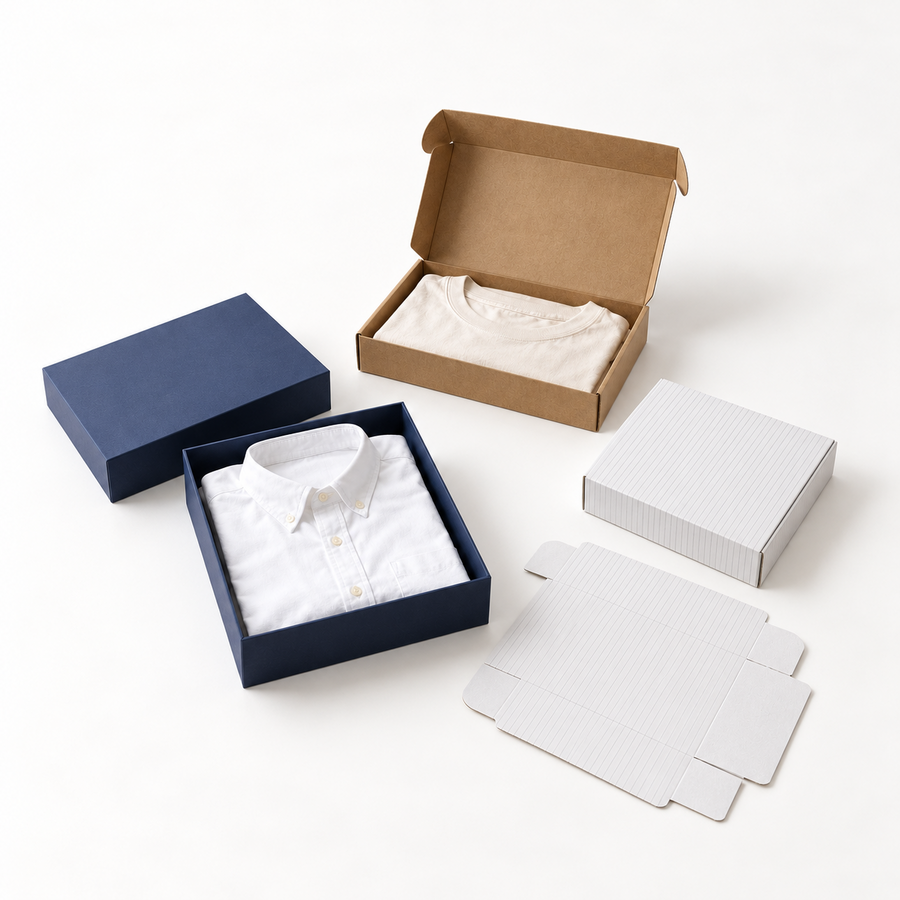
The best material for apparel packaging depends on what you sell and how the customer receives it. Rigid construction can suit premium presentation, kraft paperboard can support a natural visual style, and folding cardboard cartons can offer practical retail packaging. For parcel delivery, a suitable corrugated structure often deserves consideration.
These options are not three completely separate material families. Rigid describes construction, kraft describes a paper type or surface, and cardboard is a broad term. A rigid box can have a kraft covering, while a corrugated shipping box can have brown kraft liners.
Understanding that distinction makes the buying decision clearer. Instead of asking which material is always best, ask which combination of board, structure, size, and finish suits your garment.
A box for a boutique display has different requirements from a box traveling through a parcel network. A premium gift set may also need a different opening experience from an everyday T-shirt order.
Record the garment type, folded dimensions, quantity per package, accessories, and sales channel. Include tissue, garment bags, cards, and inserts when measuring the finished pack.
Also consider what must retain its shape. A folded cotton shirt presents a different challenge from a structured hat or an embellished dress.
Start your custom clothing box brief with these product details. They give material selection a practical foundation instead of leaving it to appearance alone.
Rigid boxes generally use a firm board body covered with a decorative surface. Many arrive assembled, although collapsible rigid structures also exist.
Their stable shape and substantial feel can suit premium garments, occasion wear, curated apparel sets, and gifts. A lid-and-base or hinged opening can support an orderly presentation when the customer opens the package.
The tradeoff is that assembled boxes can occupy more storage space. Their overall dimensions and protective outer packaging may also affect shipping costs.
Consider custom rigid boxes when the presentation has a clear commercial purpose. Review a filled sample to decide whether the extra structure improves the experience enough to justify its total cost.
A rigid retail box still needs a shipping plan. Its premium appearance does not automatically make it a suitable standalone parcel container.
Kraft packaging is often chosen for its recognizable paper texture and brown appearance. White kraft options also exist, so kraft does not always mean a brown box.
A simple printed kraft carton can suit casual apparel, handmade clothing, accessories, and brands that prefer a restrained identity. The finished strength depends on the grade and construction.
Natural brown stock affects print appearance. Dark inks, open spacing, and a clearly defined logo can work well, but artwork should be checked on the selected material.
When reviewing custom kraft boxes, specify whether you need a folding retail carton or a corrugated mailer. The kraft surface alone does not tell the supplier how the package must perform.
Avoid environmental claims based only on appearance. Ask for evidence about the finished packaging, including coatings and other components.
In this comparison, cardboard refers mainly to folding paperboard cartons used for apparel presentation.
These cartons can suit folded shirts, lightweight garment sets, retail shelves, and promotional packs. Many can be supplied flat, which may make storage and handling easier.
They provide printable panels for branding and product information. However, board thickness, folds, closure design, and garment weight all affect the result.
Explore custom cardboard boxes when you need a practical carton with tailored dimensions. Check whether the proposed structure holds its shape once the garment and accessories are inside.
A lightweight retail carton may need an outer shipper for ecommerce orders. Make that decision before comparing quotations.
| Option | Useful starting point | Main question to check |
|---|---|---|
| Rigid construction | Premium apparel sets and gift presentation | Does the presentation justify storage and delivery costs? |
| Kraft paperboard carton | Natural visual identity and suitable retail products | Does the chosen grade provide enough stiffness and print contrast? |
| Folding cardboard carton | Folded garments and retail presentation | Do the fit, closure, and board suit the packed item? |
| Corrugated construction | Parcel shipping and more demanding handling | Has the filled shipping package been checked for its route? |
Use this table as a shortlist rather than a guarantee. The approved specification and sample determine whether the package suits your product.
Measure the garment in its intended fold. Include the largest size or thickest fabric variant that will use the box.
Avoid compressing the garment simply to fit a smaller carton. Pressure can strain the closure and disrupt presentation. Excess space can allow the garment to shift and require additional packing materials.
Test loading, closing, opening, and removal with the actual contents. For mixed garment sets, check that one item does not hide or distort another.
If you use one carton across several products, confirm each fit separately. A shared size should simplify operations while still protecting the presentation.
A design that looks sharp on white paperboard can appear different on brown kraft or a textured rigid-box covering.
Review logo size, text contrast, panel orientation, and important information on the intended substrate. Keep essential details away from folds and edges.
Use finishes where they serve the brand. Foil, embossing, coatings, and inside printing can add interest, but each should have a reason.
A clean layout with a well-positioned logo may communicate more effectively than several finishes competing for attention.
Ask whether the boxes arrive flat, pre-glued, assembled, or partially assembled. This affects warehouse space and packing time.
Have your team assemble and fill representative samples. Check whether they need extra tools or repeated adjustments to close the package.
Calculate the storage requirement for the planned order, including cartons of packaging rather than just individual boxes. A lower unit price may be less useful if the stock cannot be stored efficiently.
For repeat orders, retain the material description, dimensions, artwork, and approved sample reference.
Your final choice may combine materials: a presentation carton inside a corrugated shipper, or a rigid gift box with a simple paper wrap.
WOW Custom Boxes offers packaging options you can review around the garment, sales channel, and brand direction. Compare proposals using the same product and packing requirements.
To prepare a quotation, contact the packaging team with folded garment measurements, packed weight, preferred style, artwork, quantity, destination, and required date.
It depends on garment fit, presentation, storage, and delivery. Shortlist materials against those requirements, then approve a filled sample.
Yes. Their firm structure can suit premium presentation, but dimensions, interior layout, and the shipping arrangement still need review.
Yes. Review contrast and color appearance on the intended kraft surface before approving the artwork.
No. Cardboard is a broad term. Specify whether you mean folding paperboard, corrugated board, or another construction.
Yes. If the selected structures and grades suit each product. Different garments may still require different dimensions or shipping protection.
Measure the folded garment with tissue, accessories, inserts, and other included items. Record weight and quantity per package.
Yes. They can reduce assembled volume, but compare the actual case dimensions and assembly requirements for your order.
Yes. If a specific design has been assessed for that use. Do not assume a decorative rigid box is ready for parcel handling.
Use matching dimensions, quantities, artwork requirements, delivery conditions, and protection needs. Include assembly, storage, and outer packaging.
Approve material, construction, dimensions, artwork, finish, filled-product fit, packing process, and delivery requirements.