Candle box sizing starts with the complete product, not just the empty jar. Measure the vessel at its widest point, include the lid, label and any projecting details, then allow room for the insert that will hold it in place. Specify the usable inside dimensions of the box, check that the candle can be removed without force, and approve a packed sample before ordering. The same jar may need a different box when its lid, retail presentation or shipping method changes.
Use this guide to prepare measurements for custom candle boxes that fit the actual candle you sell. It covers single jars, inserts, gift sets and the difference between a presentation box and a parcel ready to ship.
A supplier’s jar dimensions are useful, but they may describe the empty vessel before the lid, label and protective components are added. Assemble a finished saleable candle and place it on a level surface. Record the widest outside measurement across the jar, its total height with the lid attached, and the shape of the base. Check handles, shoulders, raised labels or decorative elements that extend beyond the main body.
Measure more than one unit if you use jars from different batches or suppliers. A box that fits an unlabelled test jar may rub a finished label during packing. If you use a dust cover, care card, matches or a branded wrap, decide where each item will sit before finalizing the box size. Photograph the complete set next to a ruler so your packaging brief is easy to understand.
For a cylindrical jar, measure across the widest point in more than one direction if the shape is not perfectly round. For a square jar, record its width, depth and height separately. A tapered vessel needs attention at the shoulder as well as the base: an insert cut for the base alone may leave the upper part free to move.
| Part | Measurement to record | Reason it matters |
|---|---|---|
| Finished jar | Widest outside width and depth | Sets the footprint and the insert opening |
| Lid and top detail | Total closed height and widest lid edge | Determines top clearance and closure fit |
| Insert | Outside footprint, thickness and product recess | Takes up usable room inside the box |
| Cards and accessories | Finished packed size in their intended position | Prevents pressure against the candle or lid |
| Complete set | Overall length, width and height when assembled | Forms the basis of the inside box dimensions |
Use a consistent order such as length × width × height when recording dimensions, and state your units clearly. Do not mix the outside measurements of the carton with the inside measurements of the product space. If a quote lists only one set of dimensions, ask which set it describes.

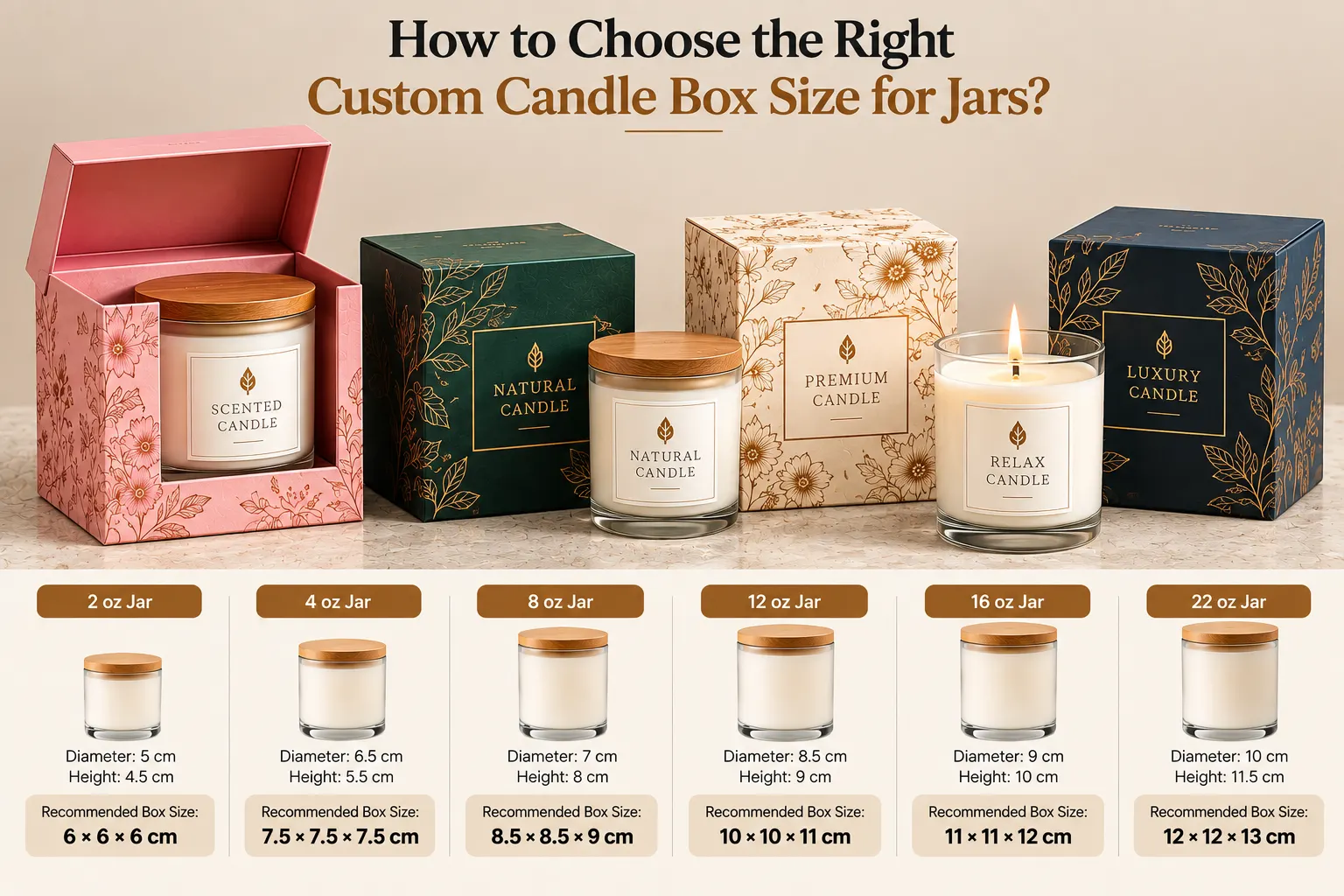
How to Choose the Right Custom Candle Box Size for Jars?
A candle lid may be wider than the glass, taller than expected, or finished with a handle. Test the box using the lid that customers will receive. Measure the total height from the base of the vessel to the highest point of the closed lid, including any decorative knob. Check that the top of the candle does not press into the inner surface when the box is closed.
The structure of the outer carton affects access. With candle boxes with lids, lift the lid off a packed sample and check whether the jar remains stable in the base. If the customer has to pull hard on the lid or turn the box upside down to reach the candle, revise the fit or the insert design.
For a tall candle, consider how far a customer’s fingers can reach down into the box. A recess that holds a jar securely still needs a removal method. Finger notches, a suitable pull feature or a shallower hold can make the difference between a secure presentation and a frustrating one. Confirm these details on the sample rather than assuming they will work from a top view of the artwork.
An insert should position the candle and limit unwanted movement. Its design depends on the jar shape, weight, finish and how the customer removes the product. A round vessel may need a different cutout from a square one; a set of two jars needs a layout that separates them. The insert material and its overall thickness also affect the final usable dimensions inside the box.
When planning candle boxes with inserts, ask for a sample that includes both the finished box and the intended insert. Place the actual candle in it, close the box and move it gently through normal handling positions. Open it again and inspect the label, lid, edges and base for scuffs or pressure marks.
Check whether a paper band, fabric lining or decorative wrap changes the fit. Presentation materials are part of the product as packed. If the insert grips the jar so tightly that staff must press it into place, packing will be slow and the packaging may mark the surface. If it is too loose, the candle may rotate and leave its label facing the wrong direction when the recipient opens the box.
Many candle jars look balanced in a cube-shaped carton, but a square outline alone does not guarantee a good fit. The jar may be wider at the lid than at the base, and the insert may need space around its outer edges. Test cube candle boxes with the finished jar and any card that sits above it. If the top panel presses on the lid, adjust the usable height before planning print.
A separate lid and base can display the candle from above. That structure also needs a comfortable way to lift the lid and remove the jar. A two-piece candle box should be tested both when freshly packed and after it has been opened and closed several times. A close fitting lid can feel secure, but it should not lift the base unexpectedly when opened.
Choose a structure based on how the candle will be displayed, packed and handled. The same inside capacity can feel very different in a deep lid design and in a box that opens from another direction. Ask someone unfamiliar with the packaging to open your sample: their first attempt is a useful test of the unboxing experience.
For a candle gift set, arrange every item exactly as the customer should see it. Include additional jars, matches, care instructions and any accessory containers. Measure the whole arrangement with its dividers or insert. Make sure the box can close without a card bending against a lid or one glass vessel touching another.
If the assortment varies, define what goes into each version. A two-candle set, a candle and diffuser set, and a seasonal bundle may require different insert layouts even if their exterior boxes appear similar. Test your largest planned combination, then check smaller combinations for empty spaces and movement. Keep a record of the approved layout for packing staff.
Extra presentation materials can change the box depth. Tissue, a booklet and a ribbon may look thin individually but can interfere with a close fitting closure when stacked above the candle. Build the sample using the final components and closing sequence, not a simplified prototype with items left out.
A printed retail box presents the candle; a shipping setup has to account for parcel handling. They may be two different layers. If a candle will be sent directly to a customer, test the complete shipment, including any outer carton and protective material. A neat display box around a glass jar should not be assumed to provide all the protection needed in transit.
Compare the final package with candle shipping boxes when planning ecommerce orders. Tell the supplier whether the candle travels in its retail carton, whether multiple candles share a parcel and how they are kept apart. Request a packed sample of the actual shipment rather than judging protection from the printed box alone.
Outside carton dimensions may also matter for storage and shipping charges. Once the candle and its protection fit properly, record both the inside fit dimensions and the final outside dimensions. That gives your team a clear basis for comparing packing options without reducing product protection merely to make the parcel look smaller.
Send the supplier the finished product measurements, the number of candles per box, intended insert, approximate packed weight, desired opening style and order quantity. Attach photos of the packed layout if you can. Once the physical sample fits, finalize artwork and confirm the approved dieline before the full order.
The most reliable candle box size is the one proven with your finished candle, lid and insert together. Clear measurements help avoid a carton that rubs the label, leaves the jar free to move or makes the product difficult to remove. Start with a packed sample, record what needs changing, and approve the dimensions only when both presentation and practical handling work.
If you have jar dimensions but need help planning the finished pack, send your layout through the Contact Us page. Include the lid, accessories and shipping method so the box discussion starts with the complete product.
For other custom packaging formats and product ideas, visit WOW Custom Boxes.
Yes. Use them as a starting point, then measure a finished candle with the lid, label and any accessories before approving the final box size.
Yes, when the candle would otherwise move or when multiple pieces need to stay separated. Test the chosen insert material with the actual product.
No. The board and box construction occupy space, so request usable inside dimensions when you are checking product fit.
Yes. If the finished jars, lids and accessories have matching packed dimensions, one structure may work. Test every variation that uses a different vessel or lid.
It depends on the complete shipping design. Test the retail pack with its intended outer carton and protection before deciding how the order will travel.