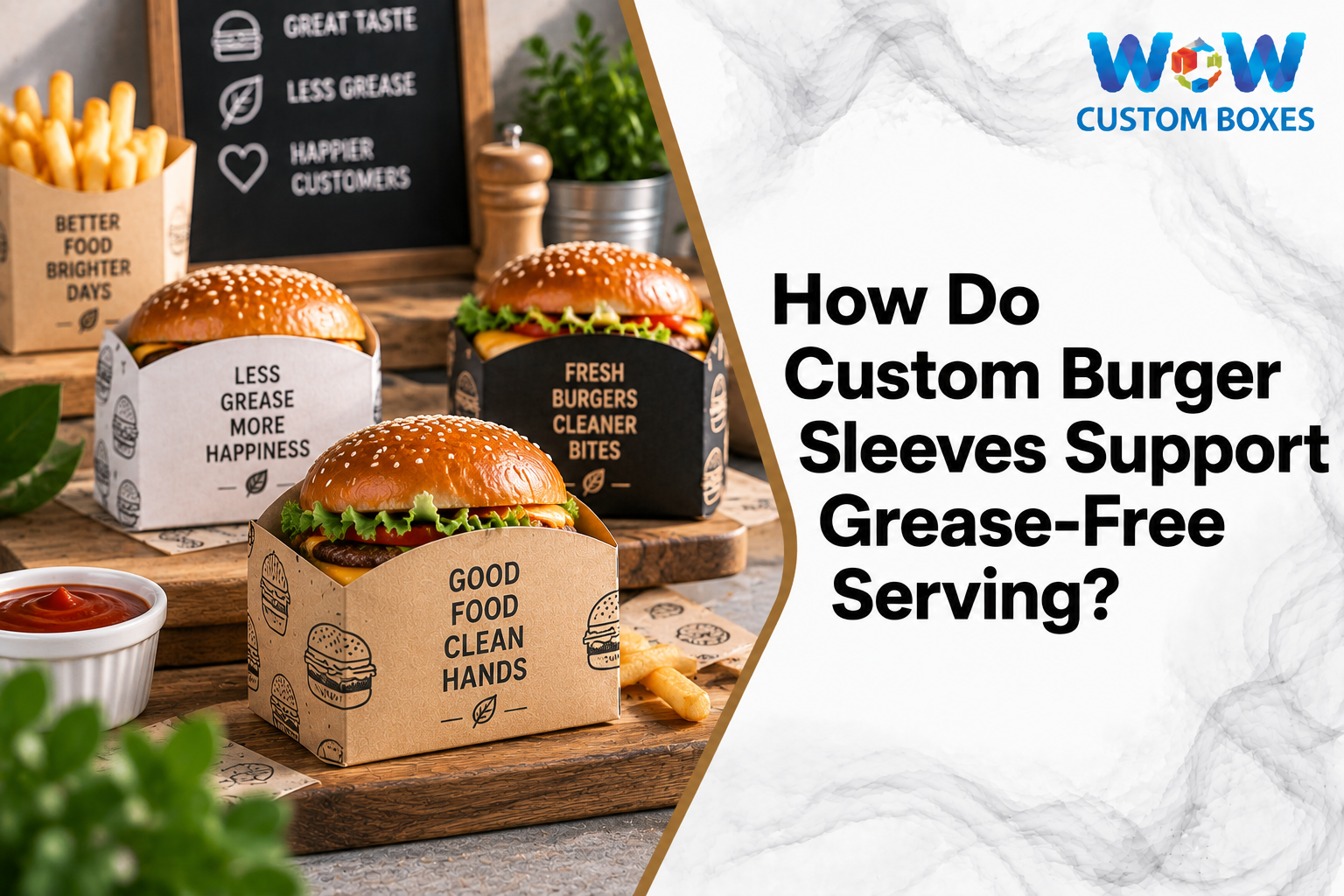
Burger sleeves are compact food packaging structures that partially surround a burger rather than enclosing it completely. They usually support the lower and side portions of the food while leaving the top accessible. This makes them particularly useful for burgers intended for immediate consumption in restaurants, cafés, food trucks, takeaways, festivals, and fast-food environments.
Well-sized custom burger sleeves can provide a dedicated gripping area between the customer’s hands and the burger. This simple design can reduce direct contact with oily buns, sauces, cheese, or fillings while allowing the customer to eat without repeatedly removing wrapping material.
The main function of a burger sleeve in grease management is separation. Instead of holding the burger directly, the customer holds part of the packaging. The sleeve acts as a physical layer between fingers and food, which can make eating more comfortable when a burger contains oily or moist ingredients.
Its effectiveness depends heavily on material selection. Food-grade papers or paperboards with suitable grease-resistant properties can slow the movement of oils through the packaging surface. A poorly selected material may absorb grease quickly, while a properly specified sleeve can maintain a cleaner outer surface for longer during normal consumption.
Grease management affects both customer comfort and food presentation. If packaging becomes heavily stained immediately after serving, the meal may appear less organized even when the burger itself is high quality. Greasy packaging can also make trays, tables, takeaway bags, and customers’ hands messier.
Restaurants that serve premium burgers, loaded burgers, cheeseburgers, smash burgers, chicken burgers, or sauce-heavy menu items should therefore consider the interaction between the food and its packaging. A sleeve cannot replace good preparation practices, but it can form part of a cleaner serving system.
Material choice has a direct effect on how a burger sleeve responds to oil and moisture. Restaurants should select packaging based on actual menu items rather than simply choosing the cheapest available paper.
| Material Type | Typical Use | Serving Benefit |
|---|---|---|
| Food-Grade Paperboard | Everyday burger serving | Provides structure and a clean holding area |
| Grease-Resistant Paper | Oily or sauce-heavy foods | Helps slow grease penetration |
| Coated Paperboard | Printed restaurant packaging | Supports presentation and surface resistance |
| Kraft Paperboard | Casual and natural branding | Combines practical handling with a rustic look |
| White Paperboard | Colorful printed branding | Provides a clean visual surface for graphics |
Kraft-style packaging is popular with restaurants that prefer a simple, natural, or casual visual identity. The board can provide useful rigidity around the lower section of a burger while allowing customers to hold the food without touching all of the bun directly.
Restaurants can use kraft burger sleeves when they want a balance between practical serving and recognizable packaging. For grease-heavy foods, however, the exact kraft grade and any grease-resistant treatment should be selected according to the menu item because appearance alone does not determine performance.
A burger sleeve must cover enough of the product to create a useful gripping area. If the sleeve is too short, customers may still need to hold oily sections of the bun directly. If it is too tall, it may interfere with eating or hide too much of the food presentation.
The ideal coverage depends on burger height, diameter, toppings, and serving style. Tall gourmet burgers may need deeper sleeves than simple single-patty burgers. The structure should allow customers to maintain control of the product while still accessing each bite comfortably.
Sizing is one of the most important elements of effective burger packaging. A sleeve that is excessively loose may allow the burger to slide downward or move sideways. This movement can push sauces and ingredients toward the edges of the packaging.
A sleeve that is too tight can also create problems by compressing the burger and forcing sauces or fillings outward. Custom dimensions help create a more balanced fit that supports the burger without squeezing it.
They can help to a degree. Because the sleeve surrounds the lower portion of the burger, it can provide support when ingredients shift during eating. Melted cheese, sauces, onions, lettuce, and other fillings may be easier to manage when the lower part of the burger remains partially contained.
However, sleeves are not fully enclosed containers. Restaurants serving extremely wet or heavily sauced products may need additional wrapping, liners, trays, or outer boxes depending on the food and delivery method.
White packaging can create a particularly clean visual presentation because grease marks and printing quality are easy to evaluate against a light background. This makes material specification especially important. The board needs to provide suitable performance while maintaining the visual style expected from the brand.
For restaurants using bright logos or colorful artwork, burger wrap sleeves can provide a clean printing base while still giving customers a practical holding area. The combination of branding and functional coverage can make the food look more organized during service.
Wrapping paper can surround a larger portion of the burger and may provide strong grease-management benefits when suitable grease-resistant paper is used. However, customers often need to fold or pull the paper down as they eat.
Burger sleeves use a more structured format. They stay around the lower portion of the burger and provide consistent support without completely covering the food. This can make them convenient for restaurants where customers begin eating immediately after receiving their order.
| Feature | Burger Sleeves | Wrapping Paper |
|---|---|---|
| Structure | More rigid | Flexible |
| Grip Support | Provides a defined holding area | Depends on how paper is folded |
| Food Visibility | Leaves top portion visible | Can cover most of the burger |
| Branding Surface | Consistent visible panels | Branding changes as paper folds |
| Immediate Eating | Highly convenient | May require adjustment while eating |
Burger sleeves are ideal for direct serving and convenient eating, but some situations require greater enclosure. Delivery orders, long takeaway journeys, highly sauced burgers, and products requiring more structural protection may perform better inside an enclosed burger box.
Restaurants handling these situations can consider greaseproof burger boxes as another relevant packaging format. A restaurant may even use different solutions for different order types—for example, sleeves for dine-in service and enclosed boxes for delivery.
By containing part of the burger and creating a barrier beneath the customer’s hand, sleeves may reduce the amount of oil or sauce transferred directly onto trays and serving surfaces. Results depend on the food itself and the material used, but appropriate packaging can make overall presentation easier to manage.
This can be particularly useful in fast-service environments where trays move repeatedly between customers and cleaning stations. Cleaner food handling may support a more organized service process.
Customers generally want to enjoy a burger without constantly wiping grease from their hands. A properly fitted sleeve provides a dedicated point to hold the product while eating. It may also reduce direct exposure to hot, oily, or sauce-covered areas of the bun.
The sleeve should still feel comfortable in the hand. Board that is unnecessarily thick can make the burger difficult to grip, while extremely thin material may lose its structure quickly. Material weight therefore needs to match both the food and the customer experience.
Printing and grease performance need to be planned together. Restaurants should not treat them as completely separate considerations. Inks, coatings, printing coverage, board selection, and food-contact requirements should all be reviewed before production.
The branding should remain visually clear while the burger is being eaten. Logo positioning is especially important because grease-prone areas may become visually affected before other areas of the sleeve.
A sleeve is visible throughout much of the eating experience, making it useful for restaurant branding. Logos, brand colors, slogans, burger names, social media details, and short promotional messages can be incorporated into the exterior design.
This means one piece of packaging can support several goals simultaneously: provide a holding area, improve food presentation, help manage grease contact, and reinforce brand identity.
Yes. Fast-food restaurants often need packaging that employees can use quickly during high-volume service. A pre-cut sleeve can provide a relatively simple packing process compared with more complicated structures.
The restaurant should test how quickly employees can place burgers into sleeves during peak periods. Packaging that performs well visually but slows down kitchen operations may not be the right solution for a high-volume business.
Burger sleeves can be particularly convenient for food trucks, street-food businesses, festivals, and outdoor events because customers may eat while standing or walking. The packaging gives them a designated place to hold the burger without needing a full plate.
In these environments, grease control becomes even more valuable because customers may have limited access to tables, cutlery, or hand-washing facilities.
Measure the burger diameter and height accurately.
Consider how much grease and sauce the burger normally releases.
Select food-grade materials suitable for the intended application.
Choose enough sleeve depth to provide a comfortable grip.
Avoid dimensions that compress the burger excessively.
Review printing and coating compatibility.
Test sleeves with freshly prepared menu items.
Check performance over the normal eating period.
Evaluate both dine-in and takeaway requirements.
Confirm storage space and required order quantity.
They can support takeaway presentation, especially when customers are expected to eat shortly after collection. A sleeve can keep branding visible and provide practical grip support while the burger is placed inside a larger takeaway bag or meal package.
Longer delivery journeys may require additional packaging because steam, heat, sauces, and movement affect food differently over time. Restaurants should test packaging under actual delivery conditions rather than assuming that a dine-in solution will perform identically during transportation.
For immediate-service applications, a properly designed sleeve may allow restaurants to use a compact packaging format rather than automatically placing every burger in a larger container. Whether this reduces total packaging depends on the menu, order format, safety requirements, and transportation needs.
The goal should be to use enough packaging to protect and present the food effectively without adding unnecessary layers that do not improve performance.
Custom burger sleeves support cleaner, lower-mess serving by creating a barrier between the burger and the customer’s hands, providing a defined grip area, helping stabilize fillings, and using materials designed to manage grease exposure during normal eating.
Their effectiveness improves when restaurants customize the sleeve to the actual burger dimensions and choose materials based on oil, moisture, sauce content, serving temperature, and eating time. They are therefore more than decorative packaging—the structure and material can directly influence how comfortably a burger is handled.
For restaurants serving burgers, grease management is an important part of packaging performance. Custom burger sleeves can help create cleaner handling, organized presentation, convenient eating, and visible branding without completely enclosing the food.
The best results come from matching the sleeve material, dimensions, grease resistance, board thickness, and coverage to the actual burger. Restaurants should test packaging with fresh menu items before ordering larger quantities. For help with burger sleeve sizing, materials, printing, or packaging specifications, Contact Us to discuss your requirements.
Not necessarily. Their performance depends on the material, coating, food composition, temperature, and length of contact, but suitable sleeves can significantly reduce direct grease contact during normal serving.
Grease resistance mainly depends on the food-grade paper or board specification and any suitable barrier treatment used in the packaging structure.
They can be suitable for many burgers, but extremely wet products may require additional wrapping, liners, trays, or enclosed packaging.
Correct sizing helps support the burger without excessive movement or compression, both of which can contribute to messy serving.
Yes. Restaurants can add logos, colors, patterns, product names, promotional messages, and other branding while selecting suitable food-packaging materials.