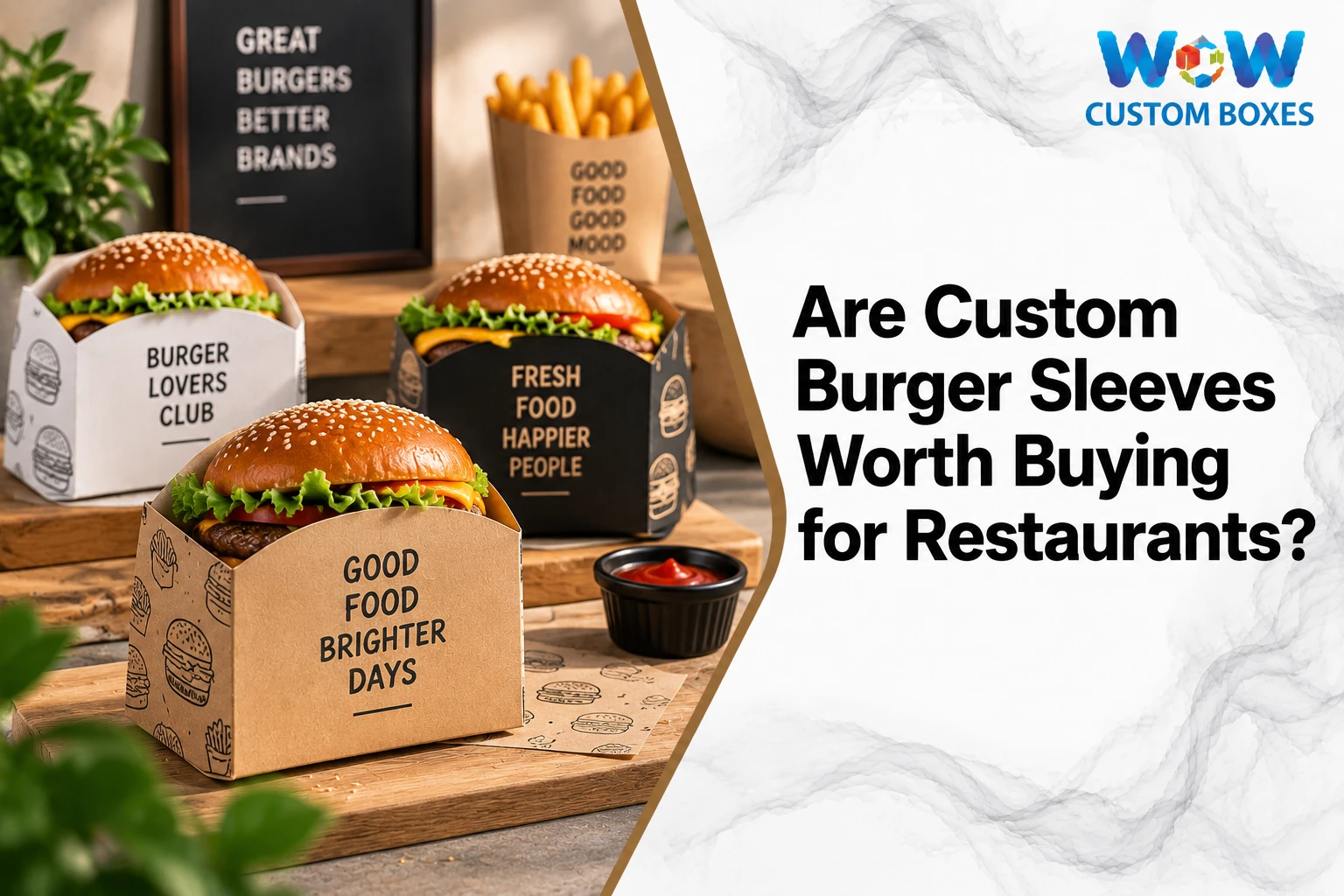
Restaurants comparing different custom packaging solutions should consider how packaging fits their menu, serving style, customer expectations, branding goals, and daily order volume. Burger sleeves can be particularly useful for fast-food restaurants, cafés, food trucks, takeaway counters, casual dining businesses, and other establishments that need practical yet recognizable Food Packaging.
Custom burger sleeves are compact paper or paperboard holders designed to wrap around part of a burger. Unlike a fully enclosed burger box, a sleeve usually leaves the top portion of the burger accessible while supporting the bottom and sides. This structure can make the food easier to hold while providing a printable surface for logos, brand colors, product names, patterns, and promotional messages.
Restaurants can use custom burger sleeves for dine-in service, takeaway meals, food trucks, festivals, catering, quick-service counters, and promotional menu launches. Their compact structure makes them particularly relevant when the burger is intended to be eaten shortly after serving rather than transported for long periods.
For restaurants that sell burgers frequently, they can be worth buying when branding, efficient serving, presentation, and customer convenience are priorities. Their value is not determined only by the price of each sleeve. Restaurants should also consider whether the packaging improves food handling, creates a recognizable brand appearance, reduces dependence on oversized packaging, and supports faster service.
The strongest value usually comes when the sleeve is designed specifically around the restaurant’s burger dimensions and brand identity. A poorly fitted sleeve may not hold the food correctly, while an overly complicated printed design may add unnecessary cost without improving the customer experience.
One major reason restaurants choose Custom Food Packaging is brand visibility. A plain wrapper serves a functional purpose, but it provides little opportunity to remind customers which restaurant prepared the meal. A custom sleeve places the brand directly around the burger while the customer is holding and eating it.
Restaurants can add logos, slogans, recognizable typography, product names, social media handles, QR codes, and signature colors to the sleeve. When the same design language appears on menus, takeaway bags, food boxes, websites, and restaurant signage, the entire brand experience can feel more consistent.
Printing turns a simple food holder into a branded communication surface. Instead of using plain packaging, restaurants can select custom printed burger sleeves to reinforce brand identity while serving food.
Printed sleeves can also distinguish different burger varieties. For example, restaurants may use different text, icons, or color accents to identify spicy burgers, vegetarian options, signature recipes, limited editions, or promotional menu items. This can support both branding and order identification when several burger types are being prepared at once.
Presentation can affect how customers perceive a meal before taking the first bite. A burger placed neatly inside branded packaging often looks more deliberate and organized than one served with loose generic wrapping.
For dine-in restaurants, branded sleeves can improve tray presentation. For takeaway customers, they can create a more distinctive product appearance. Restaurants that encourage customers to share food photos online may also benefit when their branding remains visible in pictures of the burger.
Burgers often contain sauces, melted cheese, vegetables, oils, and other ingredients that can move while the food is being eaten. A sleeve provides customers with a defined area to hold the burger instead of gripping the food directly.
When correctly sized, the sleeve can support the lower portion of the burger and help keep some ingredients contained. This makes it useful for quick-service environments where customers may be eating at a counter, walking through an event, sitting outdoors, or consuming food without a full table setting.
Material selection matters when food contains oils or sauces. Restaurants should choose food-appropriate materials that match the type of burger being served. The sleeve should retain its shape during normal serving and should not become uncomfortable to handle too quickly.
Grease resistance, board thickness, coating requirements, and food-contact suitability should therefore be considered during packaging selection. Restaurants serving particularly juicy or heavily sauced burgers may require different specifications from businesses serving relatively dry grilled products.
| Material | Suitable Use | Main Benefit |
|---|---|---|
| Kraft Paperboard | Casual, rustic, or natural branding | Simple and distinctive presentation |
| White Paperboard | Colorful printed designs | Clean surface for branding |
| Coated Paperboard | Detailed printed packaging | Improved visual presentation |
| Food-Grade Paper | Lightweight serving applications | Convenient everyday handling |
Kraft packaging can work particularly well for burger restaurants with rustic, handmade, natural, minimalist, or casual brand identities. The recognizable brown paper appearance gives the food a different visual character from bright white packaging.
Restaurants seeking this type of presentation can consider kraft burger sleeves while still adding logos, text, patterns, or other brand elements. The final design should remain easy to recognize and should complement the restaurant’s broader visual identity.
White paperboard can be useful when restaurants rely on bright brand colors, detailed illustrations, clean typography, or high-contrast printing. The lighter background gives businesses more flexibility when developing colorful Custom Printed Packaging.
For restaurants wanting a clean base for their artwork, white burger wrap sleeves can provide a simple presentation while keeping the burger easy to access. This style can suit modern fast-food brands, cafés, takeaway restaurants, and businesses using colorful visual identities.
Both Burger Packaging formats have advantages, but they are designed for different serving requirements. Sleeves emphasize accessibility and compact presentation, while Burger Boxes provide fuller enclosure.
| Feature | Custom Burger Sleeves | Burger Boxes |
|---|---|---|
| Structure | Partially covers the burger | Fully encloses the burger |
| Food Access | Immediate and convenient | Requires opening the box |
| Best Use | Dine-in and quick consumption | Takeaway and transportation |
| Branding Area | Compact visible surface | Larger print area |
| Storage | Generally compact | May require more space |
| Serving Experience | Designed for easy holding | Designed for enclosure |
Restaurants do not always need to select one format exclusively. Sleeves can be used for customers eating immediately, while enclosed Food Packaging Boxes may be more appropriate for delivery or longer takeaway journeys.
Yes. Quick-service restaurants need packaging that employees can prepare efficiently during busy periods. A simple sleeve can provide a practical serving format without requiring complicated assembly.
When sleeve dimensions are standardized for popular burger sizes, staff can pack products consistently. Restaurants with high order volumes should test how quickly the sleeves can be opened, filled, held, and presented during actual service rather than evaluating appearance alone.
Burger sleeves can support takeaway orders when food will be eaten relatively soon after purchase. They can also be placed inside larger takeaway bags or containers with fries, drinks, sauces, or other menu items.
For longer delivery journeys, restaurants may need additional outer protection. The sleeve can remain the branded primary packaging around the burger while another container provides transportation support.
Food trucks can benefit significantly from packaging that customers can hold easily. Seating may be limited, and customers often eat while standing or walking. Compact Food Containers and serving formats therefore need to balance convenience with presentation.
Burger sleeves can help keep branding visible even when food leaves the truck. This can be valuable at festivals, markets, outdoor events, campuses, sporting venues, and street-food locations where many competing food businesses may operate in the same area.
Yes. Restaurants can change sleeve artwork for seasonal campaigns, new-product launches, limited-time burgers, events, collaborations, anniversaries, or promotional offers.
A sleeve could include a QR code directing customers to an online menu, loyalty program, discount offer, social account, or promotional page. This allows physical Restaurant Packaging to connect with digital marketing without requiring a separate promotional insert.
Repeated visual exposure can make restaurant branding easier for customers to recognize. If a business consistently uses the same logo, colors, typography, and graphic style across its packaging, customers can begin associating those elements with the restaurant.
This is particularly useful for businesses operating multiple branches or selling through third-party delivery platforms. The customer may receive food away from the physical restaurant, making recognizable Branded Packaging an important part of the experience.
Food is frequently photographed and shared online. When branding is positioned clearly on the sleeve, the restaurant name or visual identity may remain visible in customer-generated images.
Restaurants should therefore consider how the packaging looks when photographed from different angles. A large recognizable logo or simple brand pattern may remain clearer on mobile screens than overly detailed artwork.
Custom packaging is not limited to large chains. Independent burger restaurants, cafés, food trucks, takeaway shops, and new food businesses can also use sleeves to create a more recognizable presentation.
Smaller restaurants do not necessarily need complex printing. A simple logo, two or three recognizable visual elements, and consistent typography may be enough to create a professional appearance.
The sleeve should be designed around the actual burger rather than a generic assumption about size. Burger diameter, bun height, number of patties, toppings, sauces, and wrapping method can all influence the required dimensions.
A sleeve that is too narrow can compress the burger or become difficult for staff to use. A sleeve that is too wide may allow the burger to move or create an untidy presentation. Testing a physical sample with the actual menu item can help identify the right dimensions.
Cost-effectiveness depends on how the restaurant uses them. The lowest-priced packaging is not automatically the best value, and premium packaging is not automatically necessary. Restaurants should compare the sleeve’s unit cost with its practical and branding benefits.
A sleeve may offer stronger value when it performs several functions simultaneously: holding the burger, improving presentation, displaying branding, helping customers eat more comfortably, and supporting promotional messaging.
Restaurants should also account for storage and operational efficiency. Packaging that arrives in a compact format and can be handled quickly by staff may be easier to integrate into a busy kitchen or service counter.
Burger sleeves are not ideal for every order. Restaurants offering long-distance delivery, unusually tall burgers, meals requiring complete enclosure, or products that release significant amounts of sauce may require additional or alternative packaging.
This is why packaging should be selected according to the specific food and service model. A restaurant may use sleeves for dine-in orders while choosing enclosed boxes for delivery. Using different formats for different situations can provide better results than forcing one package to handle every scenario.
Good burger sleeves should combine correct sizing, suitable materials, clear branding, easy handling, practical storage, and consistent production. Their design should support the food rather than interfere with the customer’s experience.
Effective sleeves also avoid unnecessary visual clutter. Logos, colors, product names, and promotional information should remain readable while the sleeve is being used. The packaging needs to work both as a functional food holder and as a branding surface.
For many burger restaurants, the answer is yes when the sleeves match their serving style and branding objectives. They can improve presentation, create additional brand visibility, support easier food handling, and provide a consistent packaging format across restaurant locations or menu items.
However, value depends on making the right decisions about dimensions, materials, printing, quantities, and intended use. Restaurants should not buy custom sleeves simply because they look attractive. The packaging should solve a practical serving need while reinforcing the brand.
Custom Burger Sleeves can be a worthwhile form of Restaurant Packaging for businesses that want to combine practical burger handling with stronger visual branding. They work particularly well for quick-service restaurants, cafés, food trucks, takeaway counters, and businesses serving burgers for immediate consumption.
Restaurants should evaluate food dimensions, grease exposure, material quality, printing requirements, serving speed, branding goals, and order quantities before purchasing. If you need assistance selecting the right material, sleeve dimensions, printing, or quantities for your restaurant, Contact Us to discuss your burger packaging requirements.
They can be worthwhile for restaurants that want branded presentation, convenient food handling, and consistent packaging for burgers served to customers.
They are used to partially hold and wrap burgers while creating a visible surface for restaurant branding and making the product easier to handle.
Yes. They can be used by burger restaurants, cafés, food trucks, takeaway businesses, catering companies, and quick-service food brands.
Yes. Sleeves can include restaurant logos, brand colors, product names, slogans, promotional text, QR codes, and other printed graphics.
They can be, provided the restaurant selects suitable food-grade materials and specifications based on expected grease and moisture exposure.